Guides / Cost
Machined or Molded PEEK: Where the Volume Break-Even Sits
October 18, 2026
Sources: manufacturer datasheets and published standards. See editorial standards.
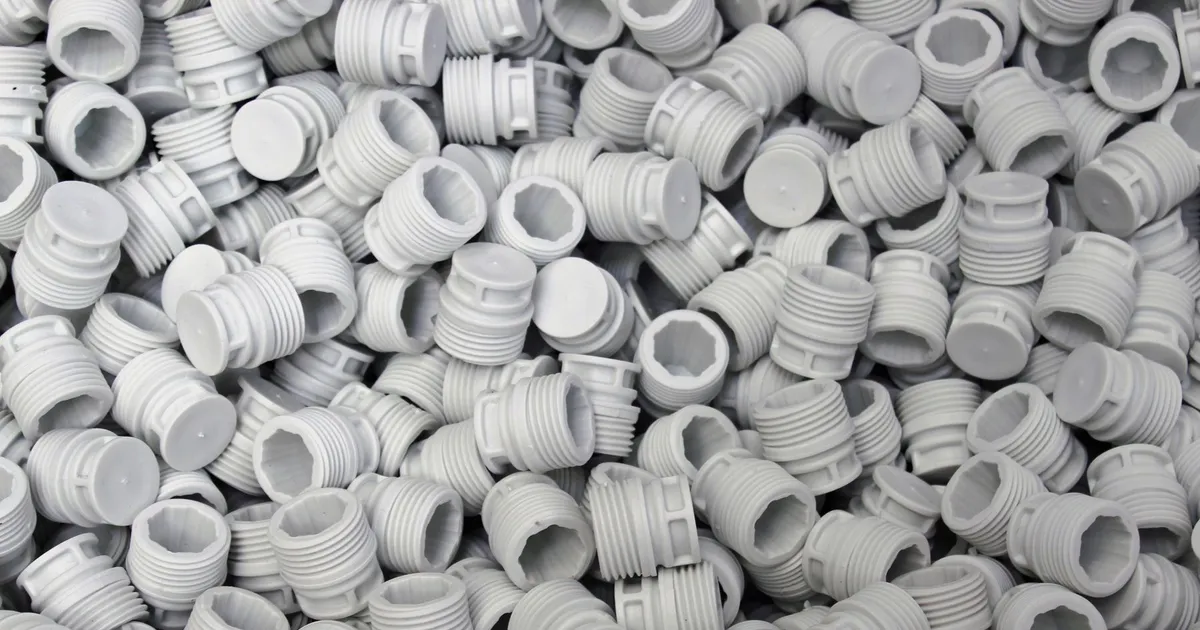
Machining PEEK is a fixed cost per part. Injection molding is a large fixed cost up front and a small cost per part after. Every buyer sourcing a PEEK part at growing volume runs into the same question: when does the mold pay for itself, and what do you give up to get there? The answer depends on arithmetic, but also on geometry, tolerance and risk, which the arithmetic leaves out.
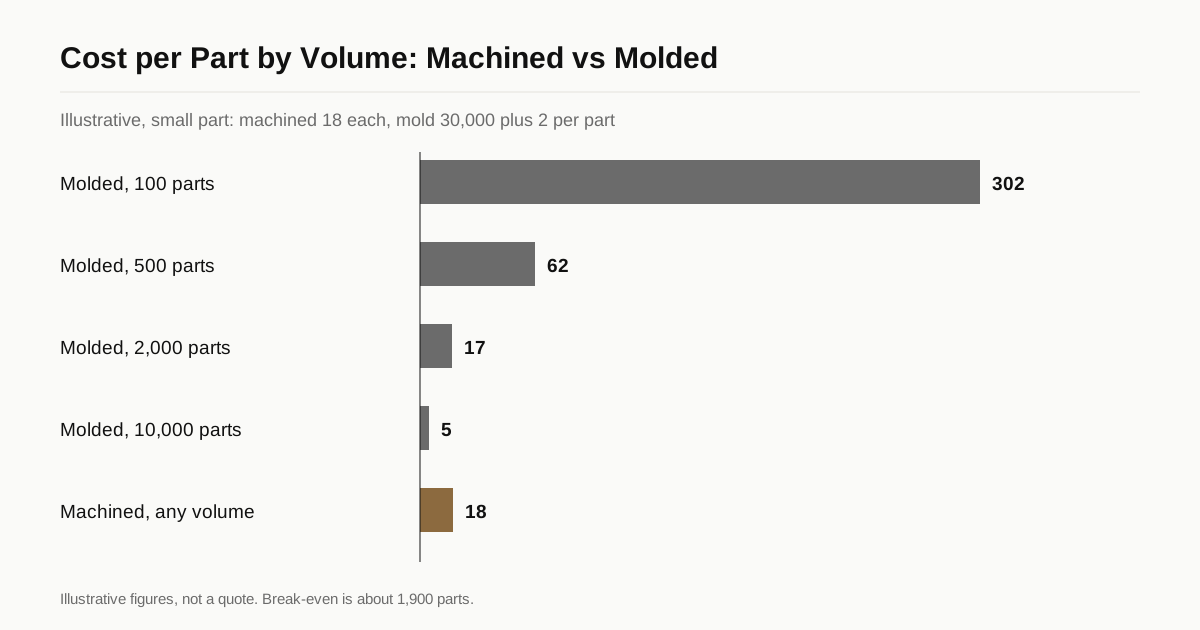
The cost curves
A machined part costs roughly the same whether you buy ten or ten thousand, apart from some setup and learning-curve savings. Material is a large share, because PEEK stock is expensive and a lot of it ends up as chips. A molded part costs little per piece but carries the price of the tool.
A worked example makes the shape clear. These figures are illustrative, for a small simple part, not a quote.
| Quantity | Machined, per part | Molded, per part (tool amortised) |
|---|---|---|
| 100 | 18 | 302 |
| 500 | 18 | 62 |
| 2,000 | 18 | 17 |
| 10,000 | 18 | 5 |
| 50,000 | 18 | 2.6 |
The assumptions are a machined cost of 18 per part, a mold of 30,000 and a molded piece price of 2. The break-even is about 1,900 pieces. A tool that costs 60,000 doubles that, and a part that machines for 40 cuts it to about 800. Your numbers will differ, but the structure will not.
What a mold really costs
PEEK molds are not ordinary plastics molds. Melt temperatures run around 380 to 400 °C and mold temperatures around 180 to 200 °C, so the tool needs hardened steel, good heating channels and venting designed for a stiff, hot melt. Typical tool costs run from tens of thousands of dollars for a simple single-cavity mold to several times that for multi-cavity or complex tools. Mold design, trials and sampling add weeks.
Molding PEEK is also a specialist job. Not every molder runs PEEK, because the barrel temperatures and drying requirements are demanding. The pool of suppliers is smaller than for nylon or polycarbonate, which affects both price and lead time.
What molding changes about the part
Geometry. Molded parts need draft on walls, fairly uniform wall thickness and radii in corners. A part designed for machining, with sharp internal corners and thick-to-thin transitions, usually needs redesign for molding.
Tolerance. Molded PEEK holds around ±0.1 to ±0.2 percent of a dimension and shrinks as it crystallises. Critical bores, sealing faces and threads are often machined after molding, so the tolerance requirement comes with a secondary operation.
Properties. Molded parts have a skin and orientation from flow. Fibre filled grades are stiffer along the flow direction than across it. Crystallinity depends on mold temperature and cooling, which changes strength, wear and chemical resistance. Machined parts come from extruded or compression molded stock with their own stress history, which is why annealing appears in machined PEEK drawings. A change from machined to molded is a change of process and needs requalification, particularly for medical and aerospace parts.
Grades and certification. Implant grade or documented lots may not be available in a molding compound, and customers may require qualification of the molded material. Check implant grade compliance before assuming a switch is possible.
When to stay machined
Stay with machining when any of these apply:
- Volumes are under a few thousand pieces a year, or demand is uncertain.
- The design is still changing. A mold change costs far more than a CNC program edit.
- Tight tolerances and surface finish apply to most features, not a few.
- Parts are large with thick sections. Thick sections mold poorly and cool unevenly.
- The material must come from certified bar or plate stock with traceability.
Machining also gives the faster path to first parts, which is why prototypes and bridge volumes almost always start there. The cost levers for machined parts are covered in the machining cost guide, and stock choices in PEEK stock forms.
When to move to molding
Move when volume is steady and high, the design is frozen, features can tolerate molded tolerances and the extra machining is limited. A hybrid approach is common: mold a near-net shape, then machine the sealing faces and bores. This keeps most of the cost saving while holding the critical dimensions.
Before committing to a tool, run a short pilot. Mold a few hundred parts, test them for fit and function and compare cost and defect rates with the machined baseline. Tooling is the commitment, so a pilot is cheap insurance.
A hybrid route and the bridge period
Most programmes do not jump straight from machined prototypes to a full molded part. A bridge period usually sits between them, and it is worth planning.
Machine first, mold later. The first thousands of parts are machined while the design settles and demand becomes clear. The mold is ordered when the design has been frozen for a while and volume forecasts are firm. Machined parts fund the learning and de-risk the tool.
Mold near-net, machine critical features. The mold produces the overall shape, and a short machining step cuts bores, sealing faces and threads. This keeps most of the cost saving and holds the tolerance where it counts. It also lets the mold be simpler, because undercuts and tight features can be left to the machine.
Keep a machined source qualified. Even after molding starts, a qualified machined route gives a fallback for tool repair, a quality problem or a demand spike. Dual sourcing costs a little in qualification and saves a lot in risk.
A few cautions apply. Material properties change between the two routes, so re-test the molded part against the original requirements. Moulded parts may need a different grade of resin from the machined stock, and certified stock for implants or food may not exist as a moulding compound. And a mold is a physical asset that needs storage, maintenance and an agreement on who owns it and where it lives. Settle that in writing before the tool is cut.
Route choice is the first step of our guide to custom PEEK parts, which then follows the part through specification and first delivery.
What to put on the RFQ
To get a fair comparison, ask for both prices. State the annual volume and the expected run size, the grade, the critical tolerances and which features could tolerate molded accuracy. Say whether the design is frozen and whether certified material is required. Send the drawing with those details and we match you with up to three shops that machine PEEK, with a reply within 24 business hours. If volume is the main driver, ask them to flag the break-even and the point at which they would refer you to a molder.
Frequently asked questions
At what volume does injection molding PEEK become cheaper than machining?
It depends on the part, but for a small, simple part the break-even is often in the low thousands of pieces, because a mold costs tens of thousands of dollars while a machined part costs a fixed amount each. Large or complex parts push the break-even higher, since mold cost rises with size.
Can a molded PEEK part hold the same tolerance as a machined one?
Not on every feature. Molded PEEK typically holds around ±0.1 to ±0.2 percent of a dimension, while machining can hold ±0.01 to ±0.05 mm on small features. Many molded parts are finished by machining the critical surfaces.
Does a molded PEEK part have the same properties as a machined one?
Not exactly. Molded parts have a skin and flow orientation, especially in fibre filled grades, and their crystallinity depends on mold temperature. Machined parts come from extruded or compression molded stock, which has its own stress history. Test the part you intend to use.
Need a quote for this part?
Send the drawing. We match you with up to 3 shops that cut your PEEK grade and reply within 24 business hours.
Get matched with a PEEK shop