Home / PAEK family
PAEK Polymers: PEEK, PEKK, PEK and PEKEKK for Machined Parts
Reference hub · Last reviewed 23 October 2026
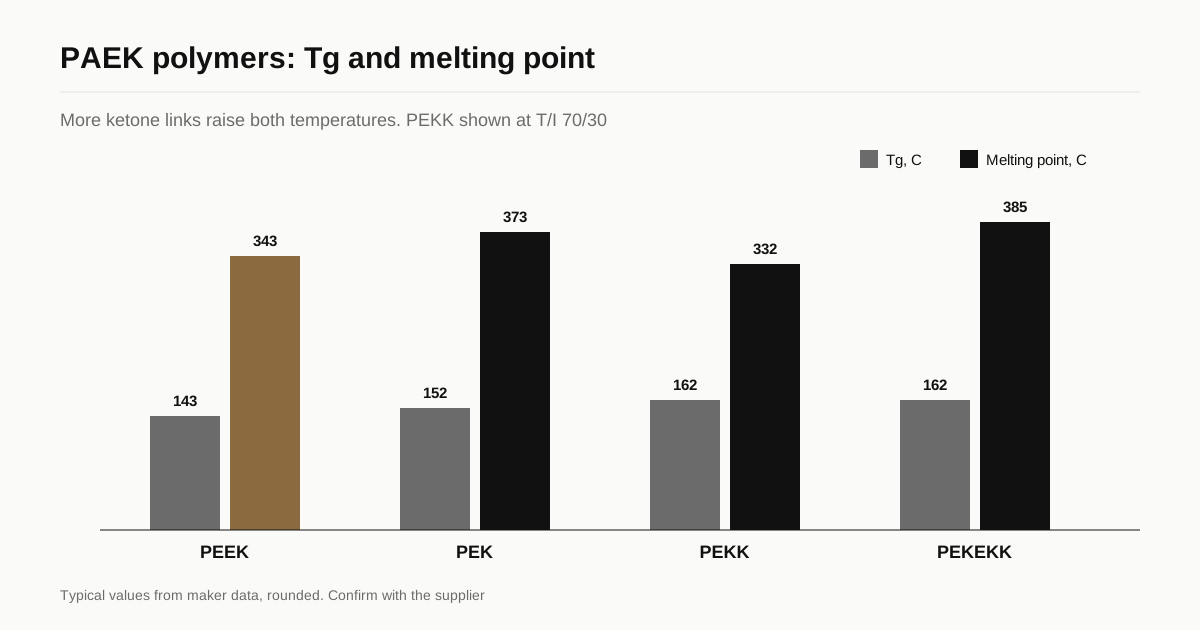
The polyaryletherketones (PAEK) are semi-crystalline polymers made of aromatic rings joined by ether (E) and ketone (K) links. PEEK, with two ethers per ketone, is the member almost every machined part uses. PEK, PEKK and PEKEKK carry more ketone links, which raises the glass transition and the melting point, at the cost of fewer stock forms and higher prices.
| Polymer | Link sequence | Ether : ketone | Tg, °C (typical) | Melting point, °C (typical) | Status for machined parts |
|---|---|---|---|---|---|
| PEEK | E E K | 2 : 1 | 143 | 343 | Standard. Widest stock range, grades and documentation |
| PEK | E K | 1 : 1 | about 152 | about 373 | Specialty, limited stock |
| PEKK | E K K | 1 : 2 | 160 to 165 | 305 to 360, set by the T/I ratio | Growing in aerospace and additive manufacturing; limited stock |
| PEKEKK | E K E K K | 2 : 3 | about 160 to 165 | about 385 | Specialty, rare as stock |
| Low-melt PAEK | Proprietary | varies | about 145 to 150 | about 305 | Composite tapes and laminates, not usual as machining stock |
Typical values from resin maker data and reference sources, rounded; DSC conditions vary. PEKK values from one maker’s 6000, 7000 and 8000 series. Confirm with the grade’s datasheet.
Why the ratio matters
Ketone links make the chain stiffer; ether links make it more flexible. The more ketone links per repeat unit, the higher the glass transition (Tg) and the melting point (Tm). Processing temperatures for the family run from about 350 to 430 °C, so a higher melting member also needs hotter moulding and extrusion, which is one reason fewer stock shapes are made from it.
For a machined part the useful number is Tg. Above it, the amorphous regions soften, stiffness falls and expansion jumps; PEEK at 143 °C is the reference. PEKK and PEKEKK push Tg to about 160 to 165 °C. That margin of about 20 °C matters for a few loaded parts that run just above PEEK’s Tg. It rarely matters below that, and it never replaces a filled grade for a part that must carry load near 250 °C, where glass or carbon fibre keeps PEEK’s heat deflection at 310 to 320 °C.
PEKK and the T/I ratio
PEKK is made from terephthalic (T) and isophthalic (I) units. The ratio changes how fast and how much the polymer crystallises:
| Kepstan series (example) | T/I ratio | Tg, °C | Tm, °C | Behaviour |
|---|---|---|---|---|
| 6000 | 60/40 | about 160 | about 305 | Slow crystallising, close to amorphous in fast processes |
| 7000 | 70/30 | about 162 | about 332 | Intermediate |
| 8000 | higher T content | about 165 | 355 to 360 | Fastest crystallising, highest crystallinity of the range |
As published by the maker. Other PEKK suppliers use their own grades.
The tunable melting point is why PEKK is popular in additive manufacturing and composite processing: a slower crystallising grade bonds better between layers. For machined parts the effect is indirect: PEKK stock can have a different crystallinity profile through its thickness than PEEK stock, so annealing and DSC checks follow the maker’s guidance, not PEEK habits. The head to head for machined parts is in PEEK vs PEKK.
Crystallinity
All PAEK polymers are semi-crystalline, but how much crystal forms depends on the cooling rate. Extruded PEEK stock is typically in the region of 30 to 35% crystallinity when properly processed; a thick section cooled fast at the surface can differ between skin and core. Crystallinity sets stiffness, chemical resistance, creep and dimensional stability after machining. Two practical consequences:
- Annealing after rough machining relieves stress and can complete crystallisation, which is why tight parts are roughed, annealed and finished. See annealing PEEK parts and the annealing calculator.
- Where a specification controls crystallinity, the check is DSC. The method is explained on the DSC crystallinity page.
Grades within PEEK
Inside PEEK itself, grades differ by melt viscosity (molecular weight), by filler and by documentation:
| Variable | Range | Effect on machined parts |
|---|---|---|
| Melt viscosity | Low flow to high viscosity grades | Higher viscosity grades are tougher; stock makers usually extrude a standard viscosity |
| Filler | Unfilled, glass fibre, carbon fibre, PTFE and graphite blends, barium sulfate, carbon nanotubes | Sets stiffness, wear, electrical behaviour and tool wear |
| Colour | Natural, black, a few colours | Affects electrical data and some compliance letters |
| Documentation | Industrial, food contact, medical, implant | Sets the paperwork and the supply route |
| Classification | ASTM D8033 cell classification for PEEK moulding and extrusion materials | Lets a drawing name properties instead of a brand |
The grade pages cover the main families: PEEK grades hub, with detail on unfilled, CF30, bearing grade and ESD PEEK. Full property ranges are on the PEEK data page.
Supply
PEEK resin is made by several producers in Europe, the US and Asia, including Victrex, Syensqo (the former Solvay specialty polymers business) and Evonik, plus a growing number of producers in Asia. Stock shapes are extruded or compression moulded by stock makers from these resins. PEKK resin comes from fewer producers, with Arkema among the best known, and PEK and PEKEKK are niche. For a machined part, the stock range decides as much as the polymer: a PEEK rod in the needed diameter is usually available from several distributors, a PEKK rod may not exist in that size.
When to choose each
| Need | Choice |
|---|---|
| General high temperature, chemical, steam or wear part | PEEK, unfilled or filled |
| Part runs loaded just above 143 °C and a filled grade is not wanted | Consider PEKK, check stock |
| Program already uses PEKK in printed or moulded parts | PEKK for matching material |
| Load near 250 °C | Filled PEEK, or PAI and polyimide; see the high performance plastics comparison |
| Cheaper alternative below 170 °C | PEI or PPSU, also in the comparison |
How the pages in this hub relate
This page maps the family. The detail pages below take one question each: how PEEK and its relatives compare with the other high-performance plastics, and later how PEKK and the filled grades behave as machined parts. Comparisons with single materials stay in the PEEK vs cluster.
Frequently asked questions
What does PAEK stand for?
Polyaryletherketone: a family of semi-crystalline polymers built from aromatic rings joined by ether and ketone links. PEEK is the best known member; PEK, PEKK and PEKEKK change the ratio and order of the links.
Why do PEKK and PEK have higher melting points than PEEK?
More ketone links make the chain stiffer, which raises the glass transition and the melting point. PEK has one ether per ketone, PEKK one ether per two ketones, PEEK two ethers per ketone.
Is PEKK easier to machine than PEEK?
Machining behaviour is similar: both are tough semi-crystalline plastics that cut cleanly and need stress relief for tight parts. The practical difference is stock: PEKK comes in fewer sizes and grades, and lead times are usually longer.
Which PAEK should a machined part use?
PEEK in almost every case, because the stock range, documentation and price are the broadest. PEKK or PEK make sense when the part needs the extra glass transition margin, or when the rest of the program, such as moulded or printed parts, already uses them.
Sources
- Wikipedia: Polyaryletherketone
- Wikipedia: Polyether ether ketone
- Wikipedia: Polyetherketoneketone
- Arkema: Kepstan PEKK resin range (T/I ratio, Tg and melting point by series)
- Victrex: PEEK 450G technical datasheet
- ASTM International: D8033-22, classification system for PEEK molding and extrusion materials
Need a quote for this part?
Send the drawing. We match you with up to 3 shops that cut your PEEK grade and reply within 24 business hours.
Get matched with a PEEK shop