Guides / Grades
PEEK, PEKK, PEK: Choosing Between PAEK Polymers for Machining
October 21, 2026
Sources: manufacturer datasheets and published standards. See editorial standards.
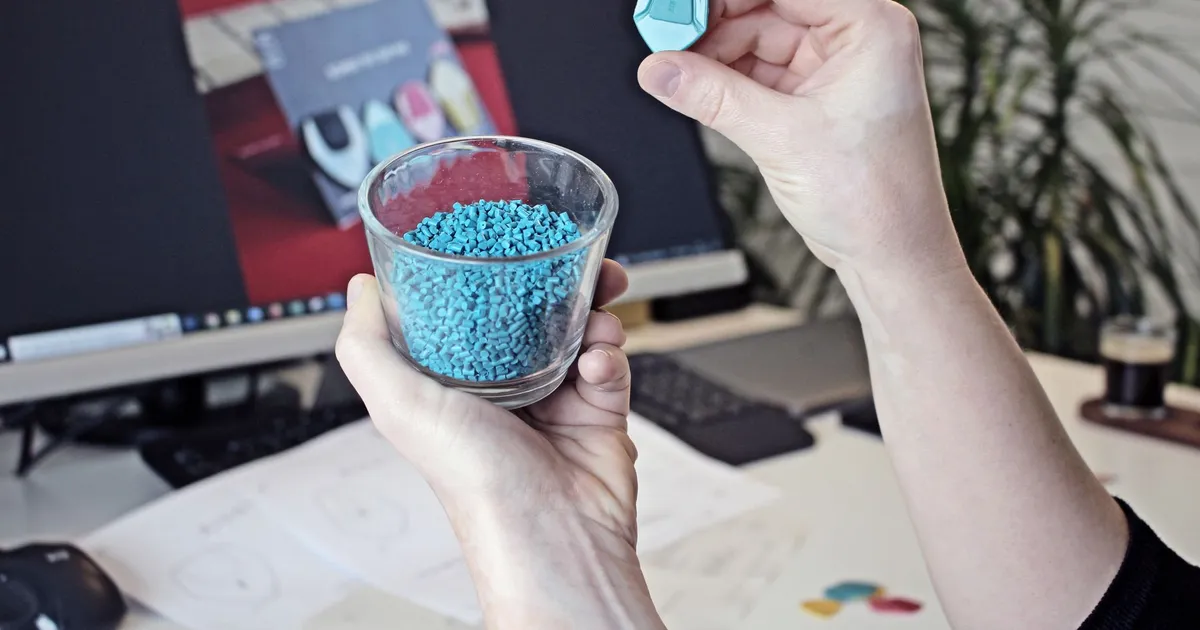
PEEK is the name most buyers know, but it is one member of a family. Polyaryletherketones, or PAEK, share a backbone of aromatic rings joined by ether and ketone groups, and the ratio of the two decides how the polymer behaves. A buyer who writes PAEK on a drawing has not specified a material. A buyer who names PEEK has, and one who names PEKK has chosen something different. Knowing the family helps when a design review asks whether another grade would do better.
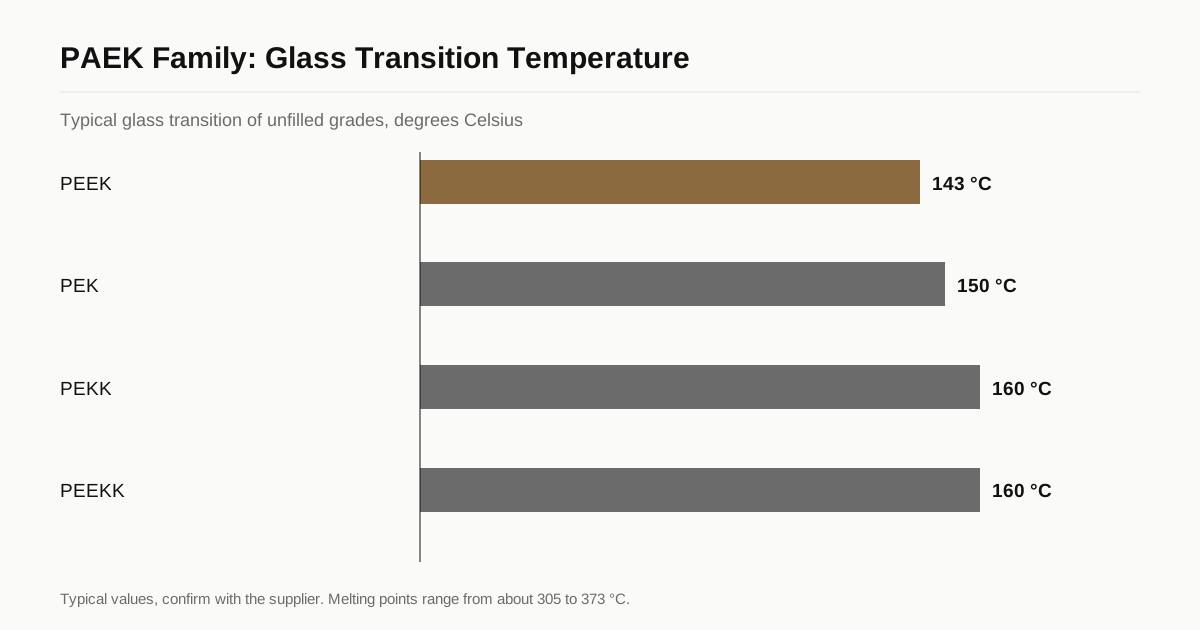
The family in one table
All values are typical for unfilled grades. Check the supplier datasheet for the grade you buy.
| Polymer | Structure ratio | Glass transition | Melting point | Notes |
|---|---|---|---|---|
| PEEK | Ether, ether, ketone | About 143 °C | About 343 °C | Widest stock range |
| PEK | Ether, ketone | About 150 °C | About 373 °C | Less common |
| PEKK | Ether, ketone, ketone | About 160 °C | About 305 to 360 °C | Varies by grade |
| PEEKK | Ether, ether, ketone, ketone | About 160 °C | About 365 °C | Niche |
More ketone groups mean a stiffer chain, a higher glass transition and usually a higher melting point. PEKK is also notable because the ratio of its two isomers can be adjusted, and that changes how quickly it crystallises and where it melts. A PEKK grade can be supplied as an amorphous material that is later crystallised, which has been used in additive manufacturing.
Where PEKK pulls ahead
PEKK offers a higher glass transition, which keeps stiffness a little further up the temperature range, and some grades show higher compressive strength and hardness. Those attributes interest designers working at sustained temperatures near the PEEK limit, in aerospace or oil and gas parts that are stiffness limited rather than melt limited.
PEKK has also been adopted in additive manufacturing for aerospace and medical parts, where its processing behaviour suits laser sintering. That does not mean it is a better machining stock. It means the stock supply has grown from the printing side, and the availability of standard rod and plate is narrower than for PEEK.
Where PEEK remains the default
Availability. PEEK rod, plate and tube come in many sizes from many stockists, in unfilled, glass, carbon and bearing grades. PEKK stock is far thinner on the ground, and you may buy from one supplier or wait for a minimum order. See PEEK stock forms for what the PEEK range looks like.
Qualification history. Decades of data, standards and customer approvals exist for PEEK, including implant grade stock sold with documented testing. A new PAEK often means starting qualification again, which costs time and money.
Price. PEKK commonly costs more than PEEK, and filled or certified grades cost more still. Request quotes for both before assuming a saving.
Know-how. Shops have machined PEEK for years and know its stress behaviour. That experience carries over to PEKK, but a shop that has never cut it will price in uncertainty.
Machining differences
PEKK and PEEK machine in the same way, with sharp positive rake tools, flood coolant and a stress relief step after roughing. The differences show up in two places.
Crystallinity. Amorphous PEKK is more transparent and softer in its response to heat, and it can crystallise during an annealing cycle, which changes dimensions. Semicrystalline stock behaves like PEEK. Ask the supplier which form the stock is and what annealing guidance applies. Annealing PEEK parts explains the basic logic.
Thermal expansion and fit. Both expand several times more than metals. A higher glass transition widens the range over which expansion stays predictable, but it does not remove the need to size fits at temperature.
Filled versions behave as you would expect: glass and carbon fibre improve stiffness and cost tool life. The PEEK equivalent is explained in CF30 vs GF30.
How to decide
Start with a property you can measure, not the name.
- If the part runs below about 250 °C and the stiffness is enough, PEEK is the sensible choice.
- If a design review needs a higher glass transition or a specific PAEK grade for approvals, name the grade and confirm that stock exists.
- If the part will be additive manufactured first and machined later, plan for the difference in microstructure.
- If a customer standard names a polymer, follow it. Substitution requires approval.
The PEEK grades compared guide covers the PEEK side of this choice in more detail.
Certification and documentation
Material choice in regulated work depends on paperwork as much as on properties. A polymer that has the right numbers but no documentation cannot go into a medical or aerospace part.
PEEK has the longest history here. Implant grade PEEK is sold with documented testing and master files in several markets, aerospace specifications name PEEK by grade and many food and pharma users hold approvals for specific PEEK grades. Other PAEK materials have their own documentation, but the coverage is narrower, and some approvals exist for powders or filaments used in additive manufacturing more than for machining stock.
Practical steps when considering a switch:
- Ask the stock supplier for the datasheet, the certificate type and any master file reference for the exact grade.
- Check whether your customer’s specification names a polymer, a grade or only a property. If it names the polymer, a substitution needs written approval.
- Confirm lot traceability, because a family name on a bar label tells you nothing about which polymer is inside.
- Budget for requalification if the part is regulated. Material change usually triggers testing even when properties look better on paper.
A shop cannot decide this for you. It can tell you which stock it can buy, in which sizes and with which certificates, and that answer often settles the question before the properties do.
Price and lead time in practice
Quotes make the difference concrete. A shop pricing a PEKK part must source stock that fewer suppliers carry, often in minimum quantities, and may have to wait for it. A PEEK part from a common bar size is often quoted from stock the same week. For a prototype with a deadline, that gap can settle the question on its own, whatever the properties say.
Ask for both quotes with the same drawing, and ask each to state stock source and lead time separately from machining time. If the PEKK stock lead time is long, ask whether a smaller test piece in PEEK can start design verification while the PEKK material is ordered.
What to put on the RFQ
Name the polymer, the grade or trade name, the filler and the specification. State whether certified stock is needed and in what form. If you are open to alternatives, say what property drives the choice, such as continuous service temperature or compressive strength, so a shop can recommend a grade it can supply. Send the drawing and we match you with up to three shops, with a reply within 24 business hours.
See also: PAEK polymers, the family overview with typical Tg and melting points.
Frequently asked questions
Is PEKK better than PEEK?
Not in general. PEKK has a higher glass transition and can be stiffer and harder, but PEEK has far wider stock availability, a long qualification history and more suppliers. The better material is the one with the property you need in the form you can buy.
Can PEKK be machined like PEEK?
Yes, PEKK machines in a similar way and the same rules apply: sharp tools, heat control and stress relief. Check the stock supplier's crystallinity and annealing guidance, because amorphous and semicrystalline PEKK behave differently under heat.
Do I need to name the PAEK type on a drawing?
Yes. PAEK is a family, and PEEK, PEKK and PEK have different melting points, glass transitions and certifications. Name the polymer, the grade or trade name and the supplier or specification, so a shop does not substitute.
Need a quote for this part?
Send the drawing. We match you with up to 3 shops that cut your PEEK grade and reply within 24 business hours.
Get matched with a PEEK shop