Guides / Grades
When PEEK Runs Out of Heat and Polyimide Takes Over
October 24, 2026
Sources: manufacturer datasheets and published standards. See editorial standards.
PEEK is the standard answer for hot, loaded plastic parts, and it is a good one up to about 250 °C. Past that, its glass transition at 143 °C and melting point at 343 °C leave less and less margin, and designers look at polyimide. Vespel, the DuPont trade name, is the best known. It holds stiffness and wear performance at temperatures that would soften PEEK. It also costs several times more and has weaknesses PEEK does not, so the switch is a deliberate trade, not an upgrade.
What the numbers say
Typical values for unfilled grades. Check the supplier datasheet for the specific grade.
| Property | PEEK | Vespel SP-1 type polyimide |
|---|---|---|
| Polymer family | Polyaryletherketone | Polyimide |
| Melts | Yes, near 343 °C | No, does not melt |
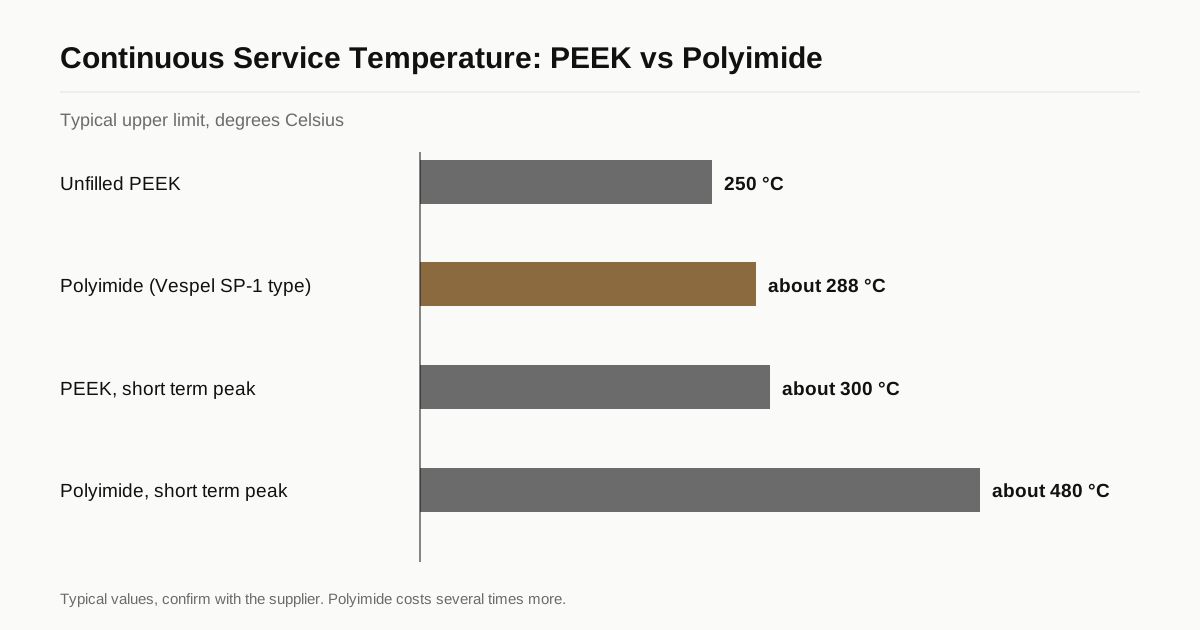
| Continuous service | Up to about 250 °C | Up to about 280 to 290 °C |
| Short term peak | About 300 °C | About 480 °C |
| Elongation at break | 30 to 40 percent | 5 to 8 percent |
| Water absorption at saturation | About 0.5 percent | About 1 to 2 percent |
| Steam and hot water | Very good | Poor over long exposure |
| Relative stock price | High | Several times PEEK |
Polyimide does not melt, so it cannot be injection molded. Parts are produced by compacting powder under pressure and sintering it, which explains the price and the limited stock shapes. Its glass transition sits far above PEEK’s, so stiffness falls off slowly with temperature instead of dropping through a transition near 150 °C as it does for PEEK. PEEK material properties shows how PEEK stiffness drops through its glass transition.
Where polyimide earns its price
Sustained heat above PEEK’s limit. Furnace and oven hardware, glass handling parts, thermal insulators and test fixtures running above 250 °C continuously suit polyimide.
Dry, high temperature wear. Polyimide, especially graphite filled, wears very little against metal at speed and temperature, and runs without lubrication. Seals, thrust washers and bushings in hot gas service use it. Bearing grade PEEK handles wear to a lower temperature, covered in the bearing grade guide.
Short heat spikes. Polyimide tolerates brief excursions to far higher temperatures than PEEK, which suits parts that see a thermal event rather than a steady load.
Vacuum and cleanroom heat. Semiconductor process parts at high temperature in dry vacuum are a common application, though outgassing and moisture need checking. See the outgassing guide.
Where polyimide struggles
Moisture. Polyimide absorbs more water than PEEK and swells with it, so parts can change size by a few tenths of a percent between dry and humid conditions. Heating a wet part quickly can blister or crack it, so shops dry polyimide parts before high temperature use.
Steam, hot water and strong bases. Hydrolysis attacks polyimide over time. A part in steam sterilisation or hot caustic cleaning has a short life. PEEK is far more tolerant, which is why it is the common choice in medical and food equipment.
Brittleness. Elongation of 5 to 8 percent means a sharp corner or a hard impact can chip a part. Edges need chamfers, and press fits need care.
Price and lead time. Stock is limited to certain shapes and sizes, and lead times can be longer. Cost per kilogram is several times that of PEEK.
Machining polyimide against PEEK
Polyimide machines to good tolerances but is abrasive and hard on tool edges, and edges chip rather than burr. Carbide or diamond tools, light cuts and good chip control apply. Parts often come as direct-formed blanks near net shape, with only critical surfaces machined. Annealing and stress relief matter for both materials, though the processes differ. See annealing PEEK parts for the PEEK schedule.
The cost difference shows up in raw material and in scrap. A mistake on a polyimide part costs far more than on PEEK, so shops often quote higher to cover risk. The machining cost guide explains how stock and process combine.
A decision path
- Continuous service below 230 °C: PEEK.
- 230 to 260 °C under load: compare creep, wear and cost for both, and test.
- Above 260 °C continuous, or short spikes above 300 °C: polyimide.
- Steam, hot water or strong base exposure: PEEK, or look at other options.
- Dry sliding wear at high temperature: graphite filled polyimide.
Alternatives between PEEK and polyimide
Moving from PEEK to polyimide is a big jump in price, so it helps to know what lies in between.
| Material | Typical continuous service | Position |
|---|---|---|
| PEEK | Up to about 250 °C | Default for hot, loaded parts |
| PEK and other PAEK grades | About 250 to 260 °C | Small gain, limited stock |
| Torlon (PAI) | About 260 °C | High strength, needs a post cure |
| Polyimide such as Vespel | About 280 to 290 °C | Highest heat, brittle, costly |
| Ceramics and metals | Above 300 °C | Different design problem |
Torlon, a polyamide-imide, sits close to PEEK in service temperature and well above it in strength at heat. It is a common step before polyimide when a part is strength limited, and it comes with its own cure step and moisture behaviour. The PEEK vs Torlon guide covers that choice.
Between 250 and 300 °C the better question is often whether the design can change. A heat shield, a thermal break or a metal insert can bring the plastic part below PEEK’s limit, and that is usually cheaper than changing material. Where it cannot, polyimide or a ceramic is the honest answer.
Pricing a polyimide part
Expect the part price to be a multiple of the PEEK equivalent. Stock cost is several times higher, scrap hurts more and shops quote higher cycle times to reduce risk. Lead time can be longer because stock sizes are limited. Two practical steps help. Ask the shop to quote a near-net direct-formed blank where the geometry allows, so less material is machined away. And ask for a PEEK version of the same part alongside, so that you can judge whether the extra margin in temperature is worth the cost. If the part is a prototype, a PEEK trial piece can prove fit and function first, with the polyimide version following once the design is settled.
What to put on the RFQ
State the continuous and peak temperature, load, environment and whether the part slides. Name the polyimide grade and any manufacturer approval, because substitutions between grades matter. Ask for a PEEK alternative so the cost gap is visible. Send the drawing and we match you with up to three shops that cut high performance plastics, with a reply within 24 business hours.
Frequently asked questions
At what temperature should I move from PEEK to polyimide?
When continuous service goes above roughly 250 °C, or when the part must keep stiffness and wear performance close to or above 260 °C. Below that, PEEK is usually the better value. Between 250 and 260 °C, check creep and wear data under your load before deciding.
Is Vespel just a stronger PEEK?
No. Vespel is a polyimide, a different polymer family. It keeps its properties at far higher temperatures but is more brittle, absorbs more moisture, resists steam and strong bases less well and costs several times more.
Can polyimide parts be machined like PEEK?
Yes, but with more care. Polyimide is hard, brittle at edges and abrasive on tools, and stock shapes are limited and expensive. Many polyimide parts are direct formed to near shape, then finished by machining, so the machining stock is only part of the story.
Need a quote for this part?
Send the drawing. We match you with up to 3 shops that cut your PEEK grade and reply within 24 business hours.
Get matched with a PEEK shop