Guides / Grades
PEEK or Ultem: Choosing a Material for a Hot Electrical Insulator
October 23, 2026
Sources: manufacturer datasheets and published standards. See editorial standards.
An insulator that sits in a hot, live assembly has two jobs. It has to keep voltage where it belongs, and it has to keep its shape while it does so. Most engineering plastics manage the first. The second is where the choice narrows, and for machined parts the shortlist is usually PEEK or Ultem, the trade name for polyetherimide, or PEI. They look similar on a datasheet and behave differently in service.
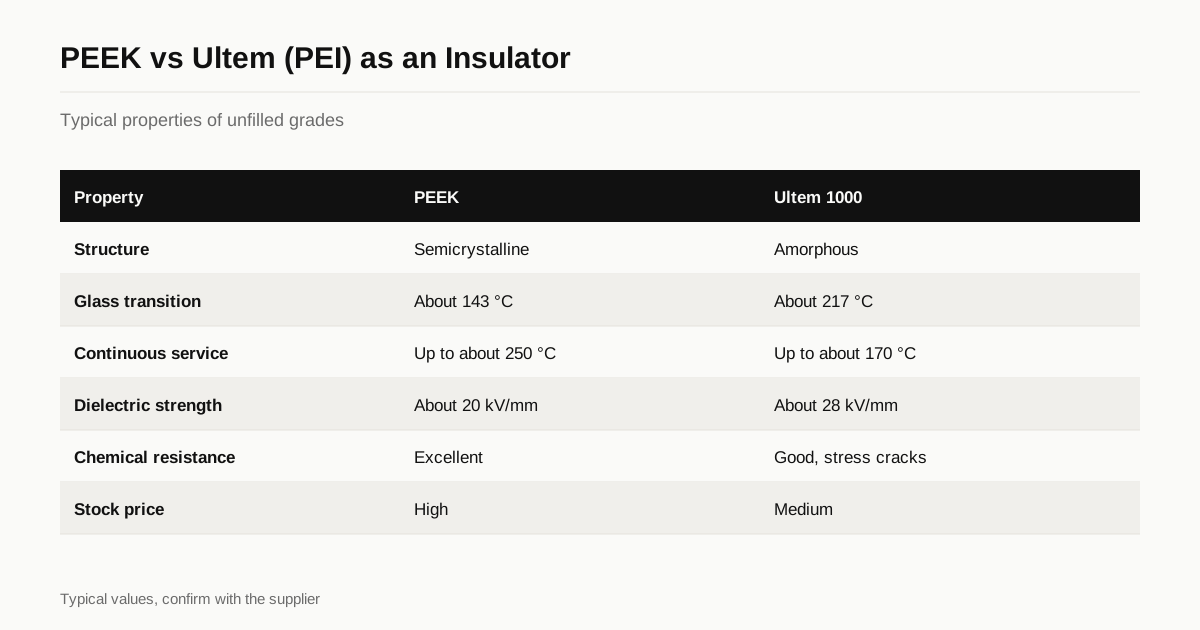
Properties that matter for an insulator
Typical values for unfilled grades. Check the datasheet for the exact grade.
| Property | PEEK | Ultem 1000 (PEI) |
|---|---|---|
| Structure | Semicrystalline | Amorphous |
| Glass transition | About 143 °C | About 217 °C |
| Melting point | About 343 °C | None, amorphous |
| Continuous service | Up to about 250 °C | Up to about 170 °C |
| Dielectric constant | About 3.2 | About 3.2 |
| Dielectric strength | About 20 kV/mm | About 28 kV/mm |
| Volume resistivity | Above 10 to the 16 ohm cm | Above 10 to the 16 ohm cm |
| Relative stock price | High | Medium |
The electrical numbers are close enough that they rarely decide the choice, and dielectric strength depends on thickness and test method. What separates them is how the material behaves when heat and mechanical load arrive together.
Why the glass transition is not the whole story
Ultem’s higher glass transition suggests it handles more heat. In practice the opposite is common for load bearing parts. Ultem is amorphous, so above its glass transition it softens rapidly and loses stiffness within a narrow band. PEEK is semicrystalline, and its crystals hold the structure together above its glass transition until close to its melting point. That is why PEEK has a continuous service rating near 250 °C and PEI is rated nearer 170 °C.
So the question to ask is what temperature the part sees under load. An insulator that only has to stand off voltage in a warm enclosure, with no clamping force, can use Ultem with margin. An insulator that is clamped, screwed down or carries a contact spring, at over 170 °C, calls for PEEK. PEEK material properties shows how stiffness changes with temperature, and the PEEK vs PEI comparison page summarises the main differences.
Chemical and moisture exposure
PEEK resists nearly all solvents, fuels, oils and hydraulic fluids, and handles hot water and steam well. Ultem resists many chemicals but is amorphous, which makes it more prone to stress cracking in contact with some solvents and to attack from strong bases, ketones and some chlorinated solvents. It tolerates steam sterilisation reasonably for a limited number of cycles, but not as well as PEEK.
For a harsh environment, such as a connector in an oil well or a sensor body in a process line, PEEK removes a failure mode that the chemical table for PEI keeps open. The chemical resistance guide lists agents of concern.
Toughness, creep and cost
PEEK is tougher than Ultem and creeps less at temperature under sustained load. Ultem is stiff at room temperature, with a high modulus, and often has dimensional stability advantages because the amorphous structure leaves less residual stress in stock shapes, so parts move less after machining. That helps with large, thin insulating plates.
Cost differs. Ultem stock is cheaper, typically a clear fraction of PEEK’s price, and it often machines at higher speed. For a part where both work, Ultem can save money. The PEEK machining cost guide explains how the stock price and the cut time combine.
Where each fits
Ultem fits insulating plates, spacers and standoffs in electronics up to roughly 150 to 170 °C, test fixtures, burn-in sockets and parts where flame retardance and cost matter more than the last 80 °C. Many Ultem grades carry UL 94 V-0 ratings.
PEEK fits insulators and connector bodies above 170 °C, parts that carry clamping load at temperature, parts in steam or aggressive media and oil and gas hardware. The extra cost buys margin on temperature, chemistry and toughness. See PEEK parts for oil and gas for typical environments, and downhole insulator comparisons for the metal side.
A decision path
- Under about 150 °C, no aggressive chemicals, rigid and cost-driven: price Ultem.
- 150 to 170 °C with load or clamping: compare creep data for both.
- Above 170 °C continuous or any exposure to steam or oil field fluids: PEEK.
- Thin or snap features that must flex: PEEK.
- Flame rating required: check the grade, because both offer rated grades and not every stock form is certified.
Machining and stability differences
How the two materials behave on the machine also affects the choice, particularly for thin or large insulating plates.
Residual stress. Ultem is amorphous and generally holds less internal stress in extruded plate than PEEK, which crystallises as it cools. A large thin Ultem plate often stays flat after machining, while a PEEK plate of the same size may bow unless it is annealed between roughing and finishing. The annealing guide explains the PEEK side.
Chip and finish. Ultem machines to a clean finish at high speed and is less prone to stringy burrs. PEEK needs sharp tools and good coolant to avoid smearing.
Moisture. Ultem absorbs more water than PEEK, roughly 1 percent at saturation against about 0.5 percent for PEEK in typical data, and both sit well below nylon. Dimensional change from water is small in both for most parts, but it is worth a line on the drawing for a tight fit.
Solvent contact during machining. Some coolants and cleaners can stress crack amorphous plastics. Shops that machine Ultem choose coolants and cleaning fluids accordingly, which matters for parts that go through a solvent wash.
Tolerance. Both can hold tight tolerances, but a thin Ultem plate usually holds flatness more easily for a given thickness.
For thick sections, connectors and clamped parts above about 170 °C, PEEK remains the safer choice. For wide, flat insulating plates at moderate temperature, Ultem often wins on cost, flatness and speed of delivery. Ask the shop which one it recommends for your geometry, and ask for a price on both.
Testing an insulator at temperature
A datasheet gives properties at room temperature and at a few points above. An insulator that matters deserves a test at its real operating conditions. A useful minimum includes an insulation resistance check at the top service temperature, a dielectric withstand test at the working voltage plus a margin, and a measurement of the part after a soak to see whether it has crept or changed size. Run the test on a machined sample made the same way as the production part, because surface finish and residual stress both affect the result.
What to put on the RFQ
State the voltage, the operating temperature and the load on the part, the environment and the flame or approval requirement. Name the grade you want or ask for both options with prices. Send the drawing and we match you with up to three shops that cut engineering plastics, with a reply within 24 business hours.
Frequently asked questions
Does Ultem handle higher temperature than PEEK?
On paper Ultem has the higher glass transition, near 217 °C against about 143 °C for PEEK. But PEEK is semicrystalline and keeps most of its stiffness to well above its glass transition, while amorphous Ultem softens rapidly near its own. For load bearing parts at high temperature PEEK usually has the edge.
Which has the better electrical insulation, PEEK or Ultem?
They are close. Both have volume resistivity above 10 to the 16 ohm centimetres and dielectric constants near 3.2. Dielectric strength is similar in the typical range, so the choice is usually decided by temperature, chemical exposure, toughness and cost rather than electrical numbers.
Is Ultem cheaper than PEEK for machined parts?
Generally yes. Ultem stock costs noticeably less and it machines with less internal stress, so cycle times and scrap are often lower. The saving matters most on larger insulators.
Need a quote for this part?
Send the drawing. We match you with up to 3 shops that cut your PEEK grade and reply within 24 business hours.
Get matched with a PEEK shop