Guides / Grades
X-Ray Opaque PEEK: What Barium Sulfate Changes in a Medical Part
October 28, 2026
Sources: manufacturer datasheets and published standards. See editorial standards.
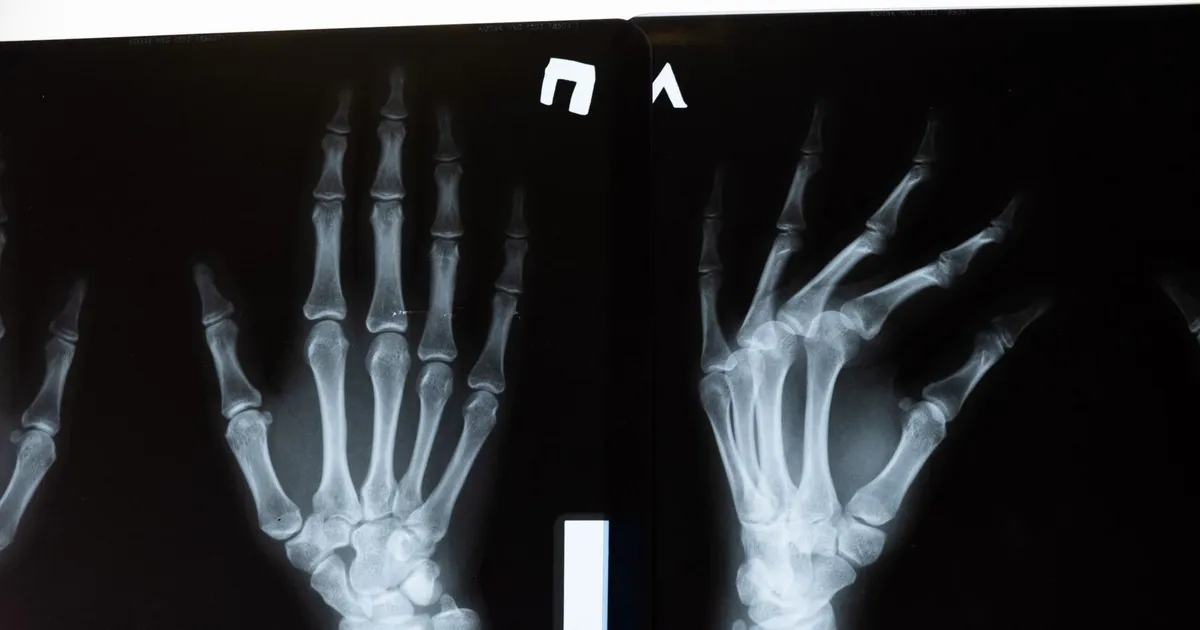
PEEK is nearly invisible to X-rays, and in most orthopaedic and spinal devices that is a feature. Surgeons can see bone growth around a PEEK cage without a metal shadow. It also creates a problem. A device that cannot be seen on a radiograph is hard to place, hard to find after surgery and hard to confirm in position. Radiopaque PEEK solves that by adding barium sulfate, and the change has consequences for the part that a drawing should anticipate.
Radiolucent, radiopaque and the trade between them
X-ray visibility depends on density and atomic number. PEEK is a light carbon, hydrogen and oxygen polymer, so it absorbs little. Barium has a high atomic number and absorbs strongly, so a plastic with fine barium sulfate particles throughout casts a shadow on the film.
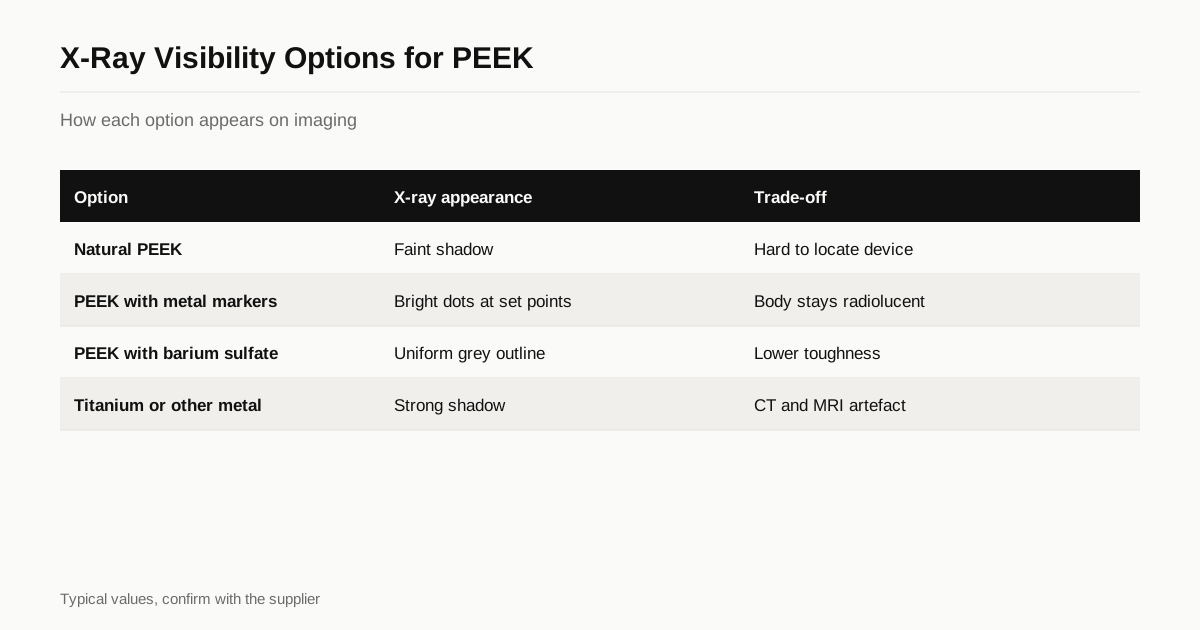
| Option | X-ray appearance | Typical use |
|---|---|---|
| Natural PEEK | Faint shadow, near soft tissue | Fusion devices where bone view matters |
| PEEK with metal marker pins | Bright dots at known points | Cages with position markers |
| PEEK with barium sulfate | Uniform grey, visible outline | Devices that need full-outline visibility |
| Titanium or metal | Strong shadow, artefact in CT | Where visibility outweighs imaging clarity |
Marker pins, usually tantalum or titanium, are a common alternative. They show the position and orientation of a cage while leaving the body radiolucent. Barium sulfate shows the whole outline, which suits catheters, tubes, surgical instrument parts and devices where position along a length matters.
What barium sulfate does to the plastic
Fillers are not free. Barium sulfate particles interrupt the polymer matrix, and the result depends on how much filler is added.
Toughness. Elongation at break and impact strength fall as filler rises. Tensile strength and modulus change by smaller amounts. Most suppliers publish the shifts for each grade, so a designer can check whether the part still meets its load case.
Density. Barium sulfate is dense, so filled PEEK is heavier than natural PEEK. For a small implant the difference is trivial, for a large instrument handle it may matter.
Colour. The compound is white or off-white to light grey, so visual inspection and laser marking behave differently from natural or black grades.
Wear and fatigue. Fatigue life under cyclic load is lower, so a spinal device that sees millions of cycles needs data on the filled grade, not on natural PEEK. The base property data is in PEEK material properties.
Implant grade, documentation and regulation
A radiopaque PEEK is a distinct material. Implant grade claims attach to the exact grade the supplier tests and documents, with a master file where available, and a filled grade has its own paperwork. Natural implant grade PEEK sold to ASTM F2026 does not carry over to a barium sulfate compound. See implant grade PEEK compliance for what to ask the supplier.
X-ray opacity can be measured. ASTM F640 describes methods for determining radiopacity of materials for medical use, and a supplier or the device manufacturer can run a test on a stepped sample. Specify the visibility target in terms of equivalent aluminium thickness or in relation to a reference, rather than as a percentage of filler, because the same filler level gives different contrast at different part thicknesses.
The shop that machines the part is not the one that qualifies the material. It buys certified stock, keeps lot traceability and documents the process. The paperwork a medical order requires is covered in the FDA documentation guide.
Machining radiopaque PEEK
Barium sulfate is soft compared with glass or carbon fibre, so tool wear is moderate, between unfilled PEEK and glass filled grades. Practical points include:
- Use sharp carbide tools and light finishing cuts. Barium sulfate particles can leave a slightly chalky surface if the tool rubs.
- Anneal between roughing and finishing, as for other PEEK. The schedule is in annealing PEEK parts.
- Clean thoroughly. Filler dust is white and shows on dark surfaces.
- Keep lot traceability. If a part must be radiopaque, a mix-up with natural stock cannot be seen without imaging.
Small features such as ribs, teeth and thin walls behave differently in a filled grade, because lower elongation makes them more prone to chipping. Radii help.
Choosing between filler and markers
The right visibility strategy depends on what the surgeon or the inspector needs to see.
Fill the whole body when the outline matters. A tube, a catheter component, a long retractor or a device that could be left behind needs a continuous image along its length. Barium sulfate gives that, and the filler level sets the contrast.
Use markers when the body should stay see-through. A fusion cage is the standard example. The marker pins show position and orientation, while the radiolucent body lets the surgeon watch bone grow through and around the device. The trade is that markers are separate parts, with their own holes, press fits and potential for loosening. They need hole tolerance and retention tested, as in any press fit.
Combine both at a lower filler level when a faint outline and sharp position marks are both useful. This needs imaging trials, because contrast depends on the thickness of the part in the beam.
Whichever route applies, define acceptance in terms of an image taken under stated conditions, such as tube voltage and a reference step wedge, so that the shop, the lab and the device maker agree on what visible means.
Marker pins and holes
When markers are used, the machined part carries small precise holes, often 1 to 2 mm diameter, drilled to a depth and position the design sets. Pin retention depends on the interference between the pin and the hole. Too loose and the pin works out. Too tight and the web around the hole cracks. Typical designs hold the hole diameter to ±0.02 mm or better. The drilling guide covers how shops hold small holes in PEEK, and the same attention to finish and edge break applies. Keep the pin material on the certificate list, because tantalum, titanium and other markers each carry their own documentation.
Visible does not mean identical
Two parts of the same design, one natural and one radiopaque, behave differently in test and in the body. A radiopaque version is typically less tough, may have a different fatigue life and can differ in surface finish after machining. Mechanical test results for the natural version therefore do not carry across, and a design that has been qualified in one grade needs its own verification in the other. Say clearly which grade each test article uses, and keep the two sets of parts apart in the lab.
What to put on the RFQ
State the grade by name and supplier, the visibility requirement and method, whether marker pins are needed and the documentation required. Include the cleaning level and packaging. If your device is regulated, say so up front. Send the drawing and we match you with up to three shops, with a reply within 24 business hours.
Frequently asked questions
Is natural PEEK visible on X-ray?
Barely. Natural PEEK is radiolucent, so it shows as a faint shadow close to soft tissue. That is useful for seeing bone growth around an implant but makes the device itself hard to locate, which is why radiopaque grades and metal markers exist.
How much barium sulfate is in radiopaque PEEK?
It varies by supplier and grade, from a few percent to roughly a fifth by weight. More filler means more visibility and a larger drop in toughness, so the level is chosen to give enough contrast without giving up the properties the part needs.
Is radiopaque PEEK implant grade?
Only if the supplier sells that specific grade with implant documentation. Implant grade claims attach to a named grade and its testing, not to PEEK in general, so check the certificate for the exact filled grade.
Need a quote for this part?
Send the drawing. We match you with up to 3 shops that cut your PEEK grade and reply within 24 business hours.
Get matched with a PEEK shop