Guides / Machining
How Deep and How Small a Hole Can You Drill in PEEK
October 12, 2026
Sources: manufacturer datasheets and published standards. See editorial standards.
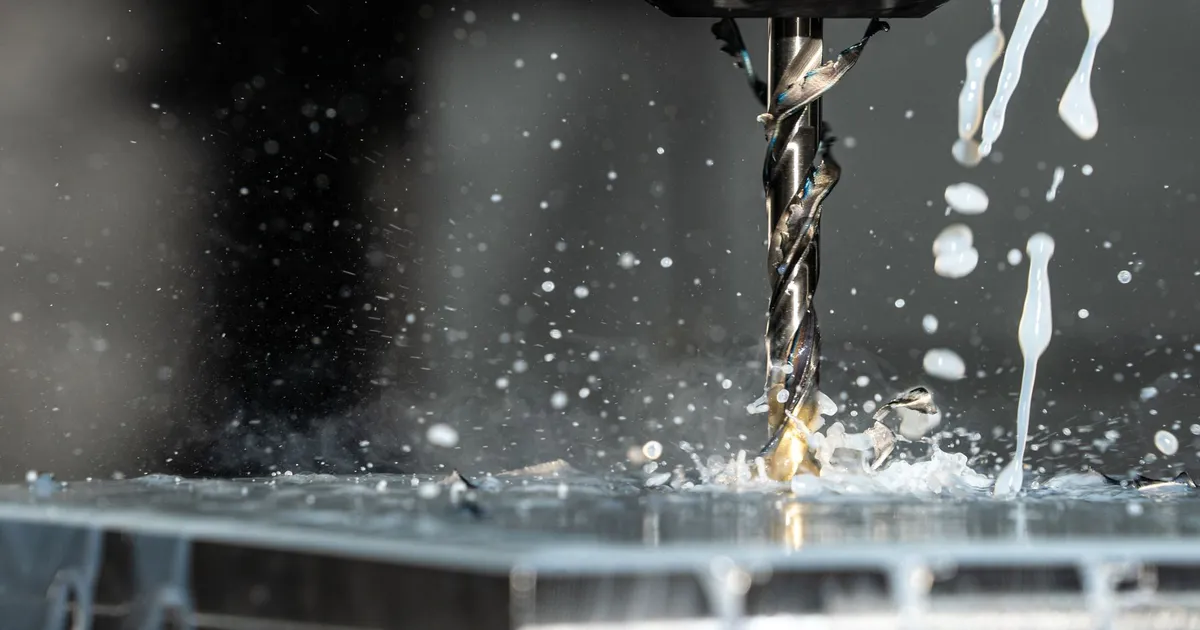
Drilling is the operation where PEEK shows its worst habits. It cannot carry heat away, it holds stress and a hole is the most enclosed cut there is: heat and chips both have nowhere to go. A hole that looks fine on the machine can arrive a few hundredths of a millimetre small, with a melted skin on the wall and a burr at the exit. The fixes are well known, and most of them belong on the drawing as much as in the shop.
What goes wrong in a deep hole
Three mechanisms cause nearly every drilled-hole problem in PEEK.
Heat. With a thermal conductivity around 0.25 W/m·K, the energy of cutting stays in the hole wall. Past the glass transition near 143 °C the wall softens, and a dull or packed drill pushes it around instead of cutting it. The result is a glazed bore, or a bore that is smeared and tight.
Chips. PEEK makes long stringy chips unless the feed is high enough to break them. In a deep hole they pack the flutes, rub the wall and carry heat back into the cut. A drill that packs once usually breaks or overheats the second time.
Stress. Extruded rod and plate hold stress from cooling. A drill that removes a core of material changes the stress balance, and the hole can ovalise or close slightly hours later. See annealing PEEK parts for why shops anneal between roughing and finishing.
Drill, coolant and peck
A plastics drill has a lower point angle than a metal drill, often 90 to 118 degrees, a high helix with polished flutes and a slightly relieved margin. Sharpness matters more than coating. A drill used in steel carries a rounded edge and will rub. Shops that run PEEK weekly keep separate drills for it.
Coolant is not optional beyond about three diameters of depth. Water soluble coolant, flooded into the hole or through the tool, carries heat out and flushes chips. Air blast is enough for shallow holes in thin sections, but it is the first thing to fail as depth grows.
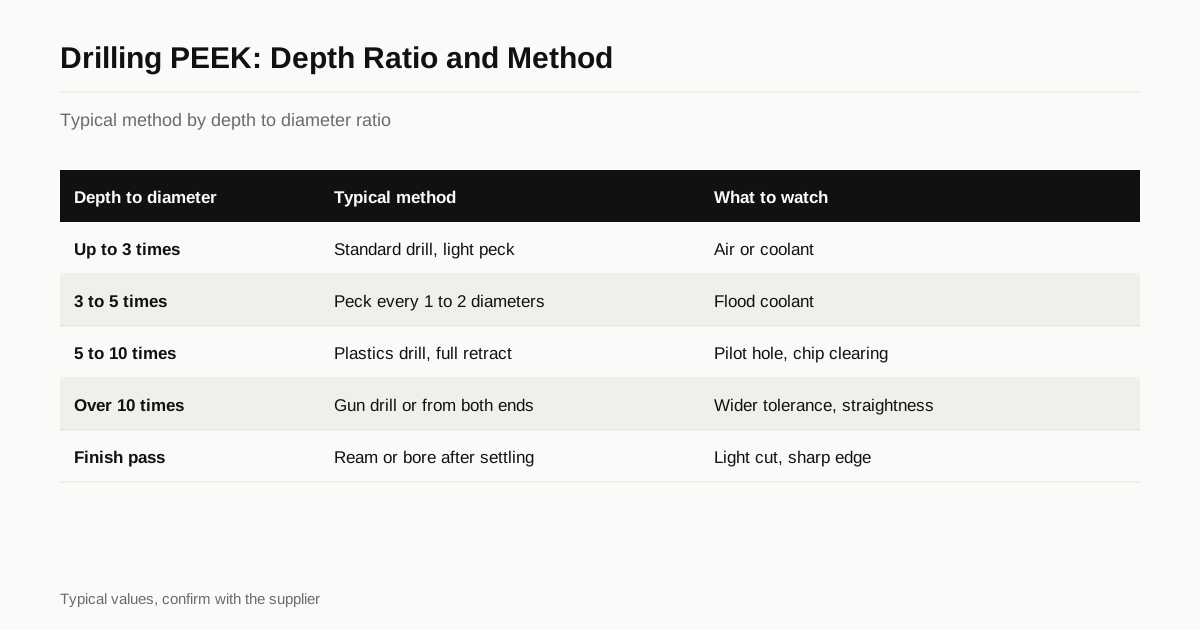
Pecking rhythm depends on depth:
| Depth to diameter | Typical method | Notes |
|---|---|---|
| Up to 3 times | Standard drill, light peck | Coolant helps, air may do |
| 3 to 5 times | Peck every 1 to 2 diameters | Flood coolant |
| 5 to 10 times | Plastics drill, full retract pecks | Pilot hole, chip clearing |
| Over 10 times | Gun drill or drill from both ends | Wider tolerance, often a straightness callout |
Typical drill speeds sit well above steel practice. Cutting data ranges for PEEK are covered in tooling, speeds and feeds.
Hole tolerance and the finishing pass
A drilled hole is a roughing operation. If a bore has to hold H7 or tighter, the shop drills undersize by a few tenths of a millimetre, lets the part settle and finishes with a reamer or boring bar. The finishing tool takes a light cut with a sharp edge and plenty of coolant, which cuts rather than rubs.
Plan for these figures when you tolerance a drawing:
- A drilled hole alone holds roughly ±0.05 to ±0.1 mm, depending on depth.
- A reamed or bored hole can hold ±0.01 to ±0.02 mm on short lengths.
- Straightness drifts with depth. A hole ten diameters deep may wander by a tenth of a millimetre or more, and a gun drilled hole may do better.
- Roundness suffers when the wall is thin or the part sits clamped, so thin sections need soft jaws or support.
Thermal fit still applies. A bore sized for a metal shaft at 20 °C opens differently at 150 °C because PEEK expands several times more than steel. The thermal fit calculator and tolerances guide show how to size a hole for the working temperature, not the shop temperature.
Exit burrs and breakout
The exit of a hole is where PEEK breaks out. The drill pushes the last of the material ahead of it, and a ragged flap or crack forms on the far side. Filled grades chip more than unfilled. Backing the part with a sacrificial plate, or reducing the feed through the last millimetre, gives a clean exit.
If the hole intersects another bore, as in a manifold or fluid block, the burr sits inside and cannot be seen. State how cross holes are cleaned and how you will check them. Deburring practice is also discussed in the machining defects guide.
Small diameters and fragile drills
Below about 3 mm, the drill itself becomes the risk. A small twist drill is stiff only in its short flute length, and a deep hole needs a long stick-out that flexes. The usual results are a wandering hole, a snapped drill left in the part or a hole that is oversize at the entry and tight at the bottom.
Practical measures for small, deep holes include:
- A spot or centre drill first, so the main drill starts on the axis instead of walking.
- Through-tool coolant where the machine has it, because a 1 mm drill cannot clear its own chips from 10 mm down.
- Full retract pecks at a shallower depth than a larger drill would take, often every half to one diameter.
- A lower feed rate towards the exit of a through hole, to avoid breakout and drill snap.
- Replacing drills on a schedule, not on failure. A drill that has cut twenty holes in filled PEEK is already dull, and in PEEK a dull drill heats the wall before it breaks.
Glass and carbon filled grades shorten drill life sharply, and small diamond coated drills are costly. If a design needs a pattern of many small holes, the shop will often quote by drill life and not only by cycle time. Moving a hole pattern from filled to unfilled PEEK, where the design allows it, is one of the quickest ways to cut that cost. The CF30 vs GF30 comparison shows what the filled grades add in return.
What belongs on the RFQ
A shop quoting a deep drilled hole needs a handful of facts before it can price the cycle and decide between drilling methods.
- The diameter, the depth and whether the hole is blind or through.
- The tolerance and surface finish, and whether the bore is a sealing, sliding or press fit.
- The grade and the stock form, because filled grades change the tooling.
- Cross holes, flats or threads that meet the bore.
- How the bore is verified, such as a pin gauge or an air gauge.
When you want a shop that treats a bore as a finished feature rather than a roughing step, send the drawing and we match you with up to three shops that machine PEEK regularly, with a reply within 24 business hours.
Frequently asked questions
What depth to diameter ratio is realistic for a drilled hole in PEEK?
Up to about 5 times the diameter is routine with pecking and coolant. Between 5 and 10 times needs a plastics drill, tight chip control and often a pilot. Beyond 10 times, shops usually gun drill or split the hole from both ends, and the tolerance has to open up.
Why does a drilled hole in PEEK end up smaller than the drill?
Heat and stress. The wall around the hole warms, expands and is cut at the expanded size, then the material cools and the hole closes slightly. Releasing stress by annealing after roughing can also move the bore. Shops drill undersize, then ream or bore after the part has settled.
Do filled PEEK grades drill differently from unfilled?
Yes. Glass and carbon fibre fill wear drill edges quickly and push the shop towards diamond coated tools. Filled grades also chip at the exit of a hole more than unfilled, so the exit edge needs support or a backing plate.
Need a quote for this part?
Send the drawing. We match you with up to 3 shops that cut your PEEK grade and reply within 24 business hours.
Get matched with a PEEK shop