Guides / Machining
Which Thread Method Works for a PEEK Part: Tap, Mill or Insert
October 27, 2026
Sources: manufacturer datasheets and published standards. See editorial standards.
A thread in PEEK is a stress concentration in a material that creeps. It will carry load, but it asks for more engagement, a sharper cutting tool and a more honest assessment of how often the joint will be opened than the same thread in steel or aluminium. Shops that thread PEEK weekly have three tools to choose from, and which one belongs on your drawing depends on size, load and repeat assembly.
Why threads behave differently in PEEK
PEEK has a tensile strength around 100 MPa for unfilled grades, but it is far less stiff than metal, with a modulus of roughly 3.6 GPa. Under a clamped screw, thread flanks deform and the plastic relaxes over time, which loosens the preload. Two consequences follow.
First, the engaged thread has to be longer than it would be in metal. A common rule of thumb is 1.5 to 2 times the screw diameter in PEEK, against 1 times in steel. Second, a shop cutting the thread has to avoid heat. PEEK that smears in the tap leaves a rough flank, and a rough flank wears faster.
Thermal expansion makes things worse at temperature. PEEK expands several times more than a steel screw, so a joint tight at room temperature changes preload as it heats. The thermal fit calculator gives a quick feel for the change.
The three ways to make a thread
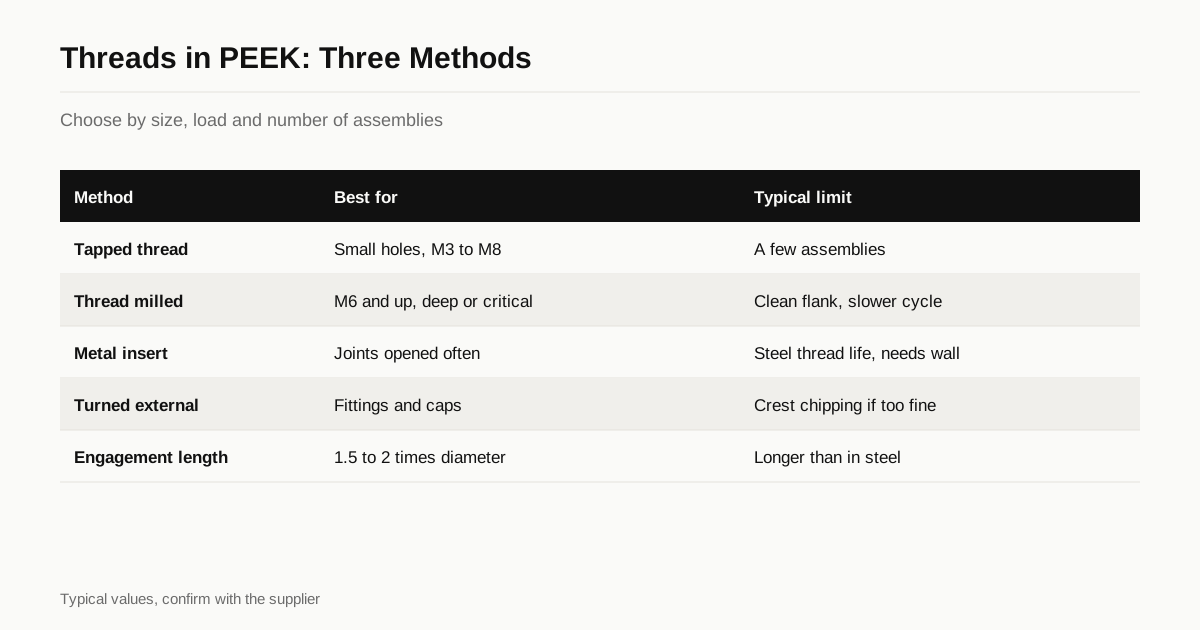
| Method | Typical use | Strength | Limits |
|---|---|---|---|
| Tapping | Small holes, M3 to M8 | Fast, cheap per hole | Chips jam blind holes, tap wear |
| Thread milling | M6 and up, deep or critical threads | Clean flank, one tool for many sizes | Slower cycle, needs a mill |
| Metal insert | Joints opened often, high load | Steel thread life | Extra part, extra cost |
| External thread by turning | Fittings and caps | Cut in one setup | Thin threads chip at the crest |
Tapping. A two flute tap with a polished flute is the default. Three or four flutes pack with chips, which then melt and weld. Use a slightly generous pitch diameter and a through hole where possible, so the chips leave ahead of the tap. Tap lubricant keeps heat down, and a sharp new tap makes a visible difference to flank quality.
Thread milling. The tool cuts the thread in a helical path with a small cut area at any instant. Chips are short, heat is low and the same tool cuts several diameters. For threads that must be accurate, such as a sealing thread or a thread in a deep bore, this is the method to choose. It needs a mill with helical interpolation, which most CNC shops have.
Inserts. A helical wire insert or a self-tapping threaded bush gives a steel thread in a plastic body. The insert spreads load into the wall and survives repeated assembly. It adds a part number, an installation step and a requirement for a wall thick enough to hold it. A thin wall that cannot take the insert will crack when it is pressed in.
Thread design details that matter
Engagement length is the first lever, but several others decide whether the thread lasts.
- Pitch. Coarser pitch gives a taller thread flank and spreads load better. Fine threads suit thin walls, but they strip more easily.
- Thread depth and wall. Keep at least one thread diameter of material around a tapped hole. A thread cut too close to an edge splits.
- Starting chamfer. A chamfer at the mouth of the thread guides the screw and protects the first flank from damage.
- Fastener material. A stainless screw into PEEK works. A plastic screw avoids galling and suits a joint that sees chemicals.
- Torque. Over-torque is the cause of most thread failures. Set a torque the plastic can hold and give assemblers the figure.
Threads in filled PEEK behave a little differently. Glass filled grades make tapping harder on tools but give a stiffer thread. Carbon filled grades make a stiffer thread still, though less tolerant of overload at the root. The property differences are in CF30 vs GF30.
Sealing and fluid threads
A tapered or fluid thread needs a different mindset. If the thread has to seal, say so on the drawing and name the standard, whether NPT, BSPT or a straight thread with an O-ring. PEEK deforms around a tapered thread over time, so most fluid designs use a straight thread with an O-ring or a flat seat rather than a taper. HPLC fittings, for instance, are covered in the chromatography fittings guide.
Checking a thread after it is cut
A thread that looks fine can still be out of tolerance, because PEEK springs back after cutting and a gauge that fits the day it is made can bind a day later. Three checks are worth putting on the order.
Go and no-go gauging. A plug gauge for internal threads and a ring gauge for external ones remain the standard check. Ask which class of fit the gauge uses, and whether the shop gauges every hole or a sample.
Visual check of the flank. A smeared or torn flank under a magnifier points to a dull tool or poor chip clearance, and it will wear faster than a clean flank at the same dimension.
Torque test. For a critical joint, tighten a sample screw to the specified torque and check that the thread holds and the head seats. A thread that strips at 70 percent of the assembly torque has no margin, and it is better found at the shop than on the line.
Measurement temperature applies here as well. A thread gauge held in a warm hand, or a part fresh from an oven, reads differently from the same parts at 20 °C. Rest the part, then gauge it. The inspection guide explains why.
Finally, burrs in thread roots can lift a screw and give a false torque reading. A light deburring step after cutting, covered in the machining defects guide, keeps the first assembly honest.
What to put on the RFQ
Shops quote threads by hole, so give the number and type of every thread. Include the thread standard and class, the engagement depth, whether the hole is blind or through, how often the joint opens and the mating material. For inserts, name the insert type and installation torque or depth. Without those details a shop will quote the cheapest method and carry the risk to the assembly line.
If your part includes a thread in PEEK that has to survive repeated assembly, send the drawing and we match you with up to three shops with threading experience on engineering plastics, with a reply within 24 business hours.
Frequently asked questions
How many assembly cycles can a thread cut directly in PEEK take?
A fine, correctly cut thread in PEEK survives a few assemblies with a plastic or soft mating part, but a steel screw tightened and removed many times wears it. For a joint opened more than about 5 to 10 times, specify a metal insert.
Is thread milling better than tapping for PEEK?
For anything above a small tap size, yes. A thread mill cuts a thread with light radial force and small chips, and one tool covers a range of sizes. Tapping is faster and fine for small blind holes if the tap is sharp, two flute and well lubricated.
Should a PEEK thread be fine or coarse pitch?
Coarse pitch carries more load in plastic because the thread flank is taller and spreads the force over more material. Fine pitch suits thin walls and sealing threads where length is limited. Match pitch to the load and wall thickness, not to the metal standard by habit.
Need a quote for this part?
Send the drawing. We match you with up to 3 shops that cut your PEEK grade and reply within 24 business hours.
Get matched with a PEEK shop