Guides / Machining
Specifying Swiss-Type Turned PEEK Parts Without Burrs or Runout
October 26, 2026
Sources: manufacturer datasheets and published standards. See editorial standards.
Swiss-type turning is the process of choice when a PEEK part is small, slender and round, and the order is for hundreds or thousands rather than a handful. The machine feeds bar stock through a guide bushing, so the tool always cuts within a millimetre or two of the support. That is what makes a 2 mm pin 30 mm long possible at all. It also moves most of the risk into the bar and the bushing, which is where a drawing and a quote should look first.
Why Swiss turning suits PEEK
PEEK is stiff for a plastic but still flexes far more than steel. On a conventional lathe a slender PEEK part bends away from the tool, and the diameter comes out tapered. A Swiss machine cuts next to the bushing, so the unsupported length is tiny and the cut stays stable along the whole part.
Heat is the second reason. PEEK carries heat away from the cut about as well as a ceramic mug does, so a long dwell in a deep cut glazes the surface. Swiss machines cut with sharp tools, light passes and a steady coolant flow, which is the right recipe for the material. If the part also needs drilling, cross holes or flats, the live tooling on the machine does it in the same setup. Cutting data ranges are covered in PEEK tooling, speeds and feeds.
The bar decides the batch
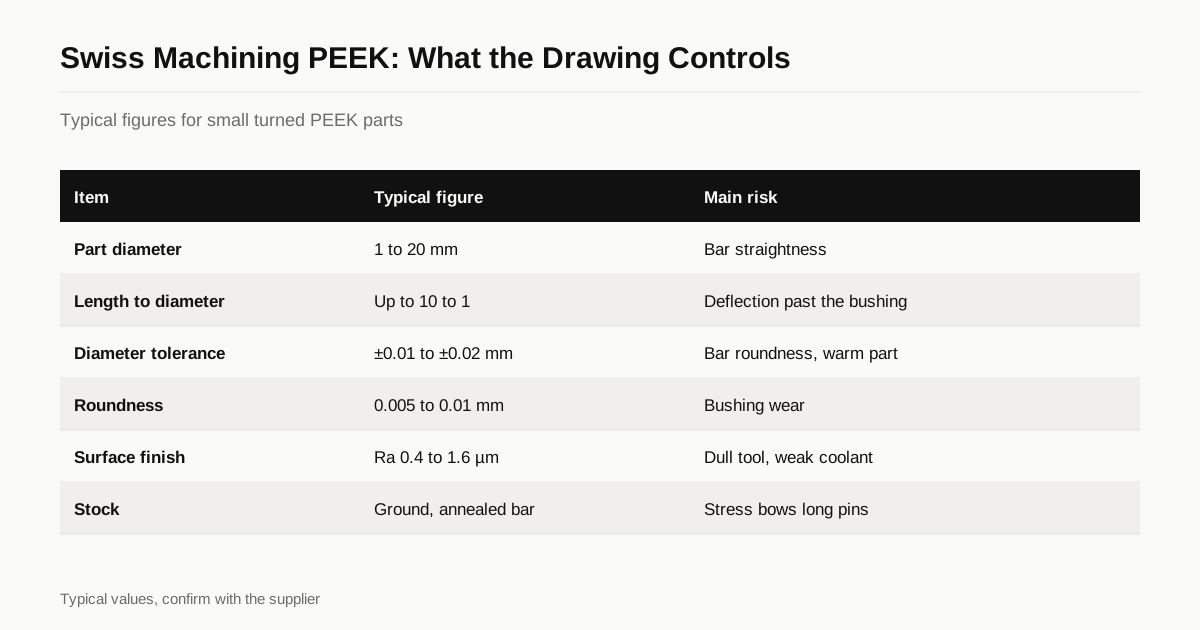
The guide bushing is sized to the bar, so the bar has to be round and straight to a tight band. Standard extruded PEEK rod is neither. Most shops specify ground rod, sized a few hundredths of a millimetre under the bushing bore.
| Item | Typical figure | Why it matters |
|---|---|---|
| Part diameter | 1 to 20 mm | Most Swiss work sits under 12 mm |
| Length to diameter | Up to 10 to 1 and beyond | Bushing support makes this possible |
| Diameter tolerance | ±0.01 to ±0.02 mm | Needs ground bar and a stable temperature |
| Roundness | 0.005 to 0.01 mm | Depends on bar quality and bushing wear |
| Surface finish | Ra 0.4 to 1.6 µm | Sharp tool and steady coolant |
| Annealed bar | Preferred | Less movement after cutting |
Annealed bar matters because extruded rod holds stress from cooling. A pin turned from stressed bar can leave the machine straight and arrive at the customer bowed. Ask whether the stock is annealed and keep the reasoning from annealing PEEK parts in mind when the part is long.
Filled grades change the equation. Carbon and glass fibre wear the bushing and the tool faster, and a glass filled bar can leave fibre ends on the surface. Both are workable but raise the cost per part. The grade comparison is in CF30 vs GF30.
Burrs and cut-off marks
Burrs on PEEK are not hard, but they are stringy, and they stay attached until something knocks them off, usually in the customer’s assembly line. Three places produce most of them.
Cut-off. The part is parted from the bar with a small nub or pip on the end face. Parting with a sharp, fresh blade and a light final feed leaves a smaller pip. If the end face is a sealing or mating surface, say so, because the shop then plans a sub-spindle finishing cut that removes it.
Edges after drilling and cross holes. A cross hole raises a burr on its exit side that the next operation will not see. List which holes need deburring and how, whether chamfered at the machine or cleaned by hand.
Threads and grooves. Narrow grooves trap stringy chips. The deburring options, and what each costs, are in the machining defects guide.
A chamfer or edge break stated on the drawing, for example 0.1 mm by 45 degrees, costs far less than a vague note that says remove burrs. It tells the shop what the finished edge looks like and gives the inspector something to measure.
Concentricity and runout
Concentricity between two diameters on the same part depends on one thing above everything else: whether both were cut without letting go of the bar. A Swiss machine with a sub-spindle passes the part from main to sub spindle without releasing it fully, which keeps the axis consistent. A part that comes off the machine and goes into a collet on a second machine has been re-referenced, and a few hundredths of a millimetre of drift is normal.
For drawings, this means three decisions. Datum the features that need to run true to one diameter, not to a face. Say which feature is the primary datum. Accept that anything cut in a second operation carries extra tolerance, and widen it, or move the feature to the first operation.
Measurement also matters. A part 3 mm in diameter deforms under a caliper’s jaws, so the shop should be using non-contact or light-force methods. Temperature and moisture move PEEK dimensions slightly. Inspection practice is in PEEK tolerances.
When Swiss turning pays off
A Swiss lathe earns its keep on small, long, round parts at repeat volume. It is the wrong tool for a short, fat part, and the quote reflects that.
| Situation | Better route |
|---|---|
| Under 12 mm diameter, length over 3 times diameter, hundreds or more | Swiss turning |
| Over 32 mm diameter or short and stubby | Conventional CNC lathe |
| Prismatic part with pockets and flats | Milling, possibly after turning |
| One to ten prototypes | Whichever shop has the bar and the program ready |
Setup is the main cost on a short run. The shop loads the bar, sets the guide bushing, proves the program and runs first article parts before the batch starts. Spreading that over ten parts gives a high unit price, and spreading it over a thousand gives a low one. Bar waste matters too, because the last 100 to 150 mm of every bar cannot be machined and PEEK stock is expensive. A shop that runs PEEK often buys bar in sizes that match the bushings it already holds, which saves both waste and lead time. The machining cost guide explains how stock and cycle time combine.
What to send with the RFQ
Swiss work is quoted on setup plus cycle time, so quantity and repeat orders change the price sharply. Include:
- Grade, filled or unfilled, and whether annealed bar is required.
- Diameter, length and every tolerance that is not standard, with the datum scheme.
- Edge condition on every cut-off face and cross hole.
- Annual quantity and batch size.
- Cleaning and packing requirement, particularly for medical and semiconductor work.
When the part is a small medical component, add the documentation that goes with it. Send the drawing and we match you with up to three shops that run Swiss lathes on plastics and reply within 24 business hours.
Frequently asked questions
What is the smallest PEEK part a Swiss lathe can turn?
Diameters under 3 mm are routine on a Swiss machine in unfilled PEEK, and some shops go below 1 mm. The limit is usually not the machine. It is how straight the bar is, how well the burr is controlled and whether the part survives handling and cleaning afterwards.
Why does PEEK bar stock need to be ground for a Swiss lathe?
The guide bushing supports the bar a fraction of a millimetre from the cut. Extruded rod is not precisely round or straight, so it either binds in the bushing or rattles in it. Ground or centreless ground rod, sized to the bushing, gives the support the process depends on.
Can Swiss turning hold concentricity between features on a PEEK part?
Yes, when the features are cut in one setup or handed to the sub-spindle without re-clamping. Concentricity is lost when a part is removed and re-chucked, so ask which features are made in the same hold and which need a second operation.
Need a quote for this part?
Send the drawing. We match you with up to 3 shops that cut your PEEK grade and reply within 24 business hours.
Get matched with a PEEK shop