Guides / Sourcing
How Hard Can You Load a PEEK Gear or Thrust Washer
October 17, 2026
Sources: manufacturer datasheets and published standards. See editorial standards.
PEEK gears are not a way to move a lot of torque. They are a way to move torque where steel gears cannot go, in hot, wet, chemical or vacuum environments, where noise matters or lubricant is not allowed. Within that niche they work well and last a long time. Outside it, the load limit shows up quickly. The design question is how much load a PEEK tooth or a PEEK washer face can carry, and a drawing should reflect the answer.
Where PEEK gears make sense
PEEK gears appear in medical devices, semiconductor tools, pumps, food and pharma equipment and instruments. The reasons are consistent.
- No lubricant. Dry running avoids contamination in clean or vacuum applications.
- Temperature. PEEK holds shape and strength to about 250 °C, far beyond nylon or acetal.
- Chemicals. Most fluids and cleaning agents leave it unchanged.
- Low noise. A plastic tooth damps vibration and runs quieter than steel.
- Low weight. Lower inertia helps in fast reversing drives.
Where they do not make sense: high torque drives, shock loads and gears that run in hot, oily gearboxes where steel has no problem. A steel pinion often drives a PEEK gear, so the softer wheel wears first and the pinion survives, which is a design choice in itself.
Load limits for gear teeth
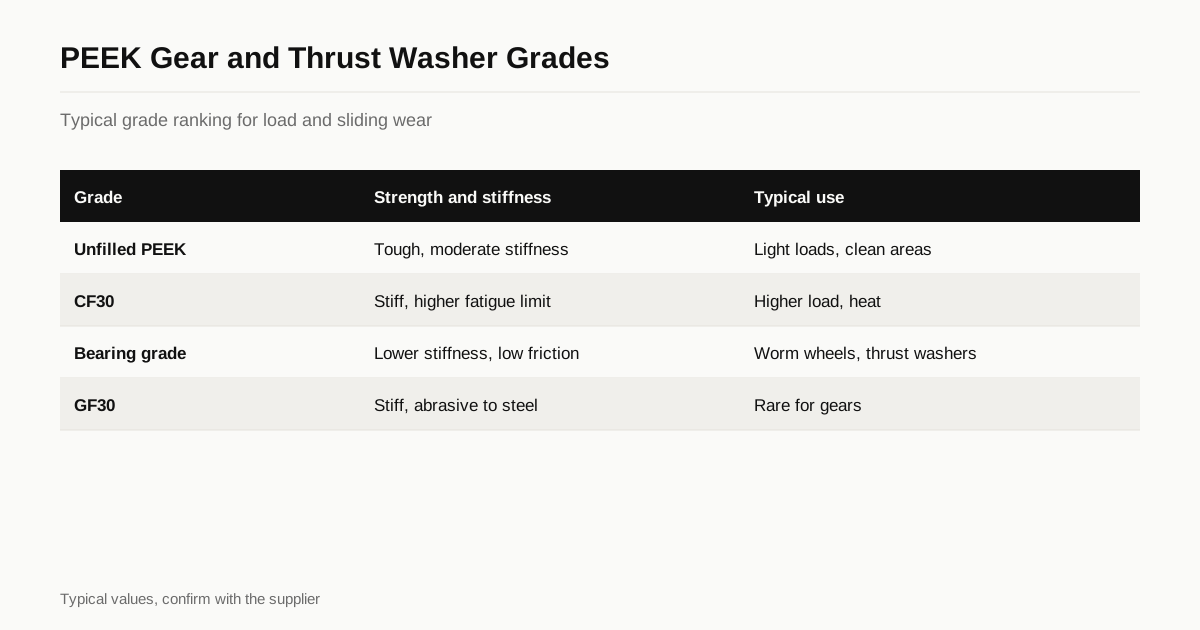
The limiting feature on a plastic gear is usually tooth root bending stress under repeated load, and then surface wear and heat. PEEK is strong for a plastic, but its fatigue limit is a fraction of its tensile strength and falls with temperature. Practical limits depend on module, face width, speed, temperature and duty cycle.
| Grade | Strength and stiffness | Wear | Typical gear use |
|---|---|---|---|
| Unfilled PEEK | Tough, moderate stiffness | Moderate | Light loads, clean environments |
| CF30 | Stiff, higher fatigue limit | Good | Higher loads, elevated temperature |
| Bearing grade | Lower stiffness, lowest friction | Best sliding wear | Worm wheels, low speed, dry running |
| GF30 | Stiff | Abrasive to steel mate | Rare for gears |
Carbon filled PEEK carries more load, but it is less tolerant of shock. Bearing grade runs well against steel at low speed but gives up stiffness. Design practice for plastic gears follows methods such as VDI 2736 for tooth stress and wear, and the supplier’s data for the exact grade is the starting point. Supplier fatigue curves are published at specified temperatures and cycle counts, and the design uses a safety factor on them.
Temperature changes everything. Properties fall as the part approaches its glass transition near 143 °C, and the figure for a gear at 120 °C is much lower than at 20 °C. The PEEK property guide shows how modulus drops with temperature.
Thrust washers and sliding limits
A thrust washer takes axial load while a shaft or a gear face rotates against it. The limits are contact pressure, sliding speed and the heat they produce together. Engineers combine pressure and speed as PV, with limiting values for each material, grade and temperature. Published PV limits for PEEK bearing grades are of the order of 1 MPa·m/s at room temperature, and unfilled PEEK is lower, but check the datasheet for exact values and for the temperature at which they apply.
Three design factors decide life:
- Counterface. A hard, smooth mate, typically hardened steel at Ra 0.2 to 0.4 µm, wears the washer slowly. A rough mate grinds it away.
- Heat dissipation. Heat leaves through the housing and shaft, and a washer in a sealed cavity runs hotter than one in open air.
- Wear rate. Specific wear rates for bearing grade PEEK are low, but they rise sharply above the PV limit. The bearing grade guide shows typical values.
A washer can fail by softening, by wear through or by creep. A flat washer with a constant clamp load creeps under sustained load, so design with enough thickness and a stop to keep it from extruding.
Machining accuracy and backlash
Machined plastic gears are cut by hobbing, milling or wire cutting from stock. Quality of DIN 7 to 9 is realistic for a good setup. Accuracy depends on how the stock behaves. Stress in the blank can warp teeth after cutting, so annealing before finishing is common. See annealing PEEK parts.
Backlash needs more room than in steel because PEEK expands more with temperature. A mesh tight at room temperature may bind when hot. The tolerance guide covers how to size clearances for temperature. A tooth profile tweak, such as a small tip relief, helps with load and noise.
Tooling matters too. Carbide hobs or cutters with sharp edges give a clean tooth flank, and a dull edge smears the surface and gives a rough profile. Cutting data are summarised in tooling, speeds and feeds.
Lubrication, noise and temperature in practice
Dry running is the attraction, but a little lubricant often extends life. A thin film of grease or a continuous trace of oil reduces friction and tooth wear and carries heat away. The trade is contamination, so use it only where the application allows. PEEK resists most lubricants, but check any additive package against the chemical data in the chemical resistance guide.
Noise falls with a plastic tooth, but the gain depends on accuracy. A poorly cut PEEK gear is louder than a good steel gear, because errors in the tooth profile excite vibration. If noise is the reason for choosing plastic, ask for a quality class and a profile check. Run a sample on the real drive before ordering a batch.
Temperature changes the picture twice. Stiffness drops as the gear warms, which raises tooth deflection and lowers load capacity. Dimensions grow, which closes the backlash. A gear designed at room temperature may bind at 100 °C or lose strength at 140 °C, and the drive may need a thermal margin in both directions. The thermal fit calculator gives a first estimate of the change in centre distance and backlash.
Mating materials and counterfaces
A PEEK gear usually meshes with a harder partner. Hardened steel, with a smooth tooth flank, wears the plastic least when the surface is clean and well finished. Brass and stainless steel pinions work at lower load. Two plastic gears in mesh run quietly and need no lubricant, but their combined load limit is the lowest of the options. For thrust washers, a ground steel counterface at Ra 0.2 to 0.4 µm is a good starting point, and an anodised or nitrided surface can add wear life where the load is high.
What to put on the RFQ
State module, tooth count, face width, quality class, grade and supplier, torque, speed, temperature, the mating material and whether the gear runs dry. For thrust washers give the axial load, speed, counterface material and finish. Name the backlash target at temperature. Send the drawing and we match you with up to three shops that cut plastic gears and sliding parts, with a reply within 24 business hours.
Frequently asked questions
Can a PEEK gear replace a steel gear?
Only at lower loads. PEEK gears run quietly, resist chemicals and can run with little or no lubrication, but their tooth root stress limit is a fraction of steel. They suit light to moderate torque, high temperature or chemical environments, and cases where noise or lubrication is a problem.
What is a PV limit for a PEEK thrust washer?
PV is contact pressure times sliding speed. It sets how much frictional heat a washer can shed before it softens or wears quickly. Bearing grade PEEK has a much higher limit than unfilled PEEK, and the supplier datasheet gives figures for each grade.
How accurate can a machined PEEK gear be?
A machined plastic gear can reach roughly DIN 7 to 9 quality on a good setup, which is adequate for most light duty drives. Accuracy depends on stock stress, tool sharpness and whether the gear is hobbed, milled or wire cut, and thermal growth changes the mesh at temperature.
Need a quote for this part?
Send the drawing. We match you with up to 3 shops that cut your PEEK grade and reply within 24 business hours.
Get matched with a PEEK shop