Guides / Sourcing
Clearance, Grade and Fit for PEEK Pump Wear Rings and Bushings
October 25, 2026
Sources: manufacturer datasheets and published standards. See editorial standards.
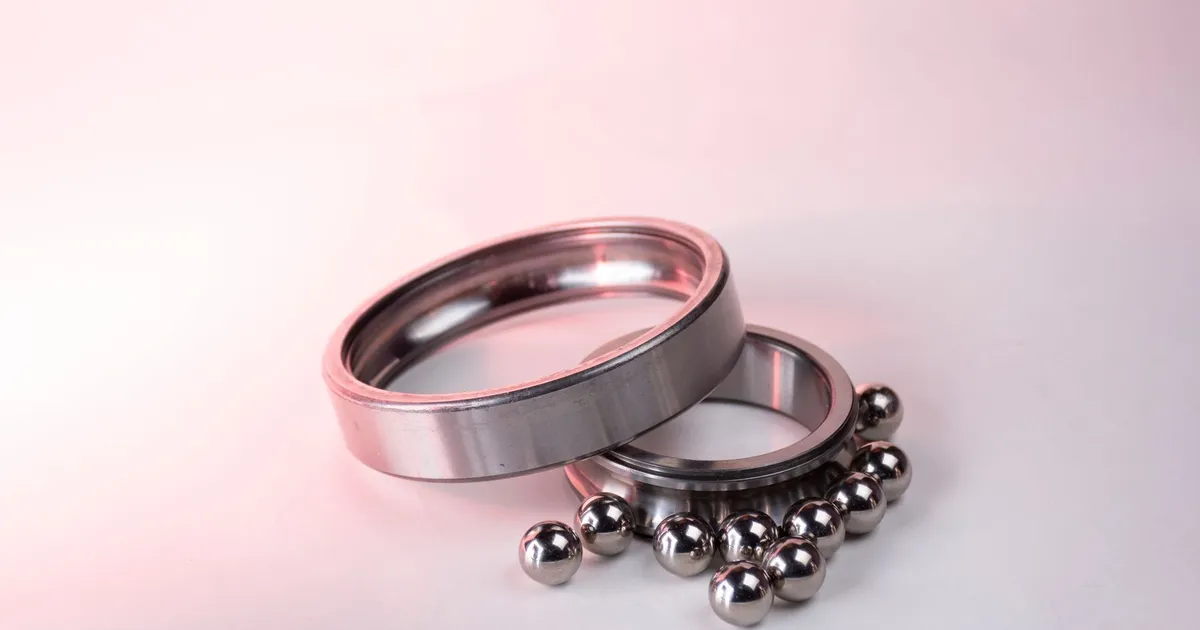
Inside every centrifugal pump, a thin gap between the rotating impeller and the stationary casing controls how much fluid leaks back from discharge to suction. Make the gap small and the pump is efficient. Make it too small and a rotor movement or a thermal shift makes metal touch metal, and the pump seizes. A wear ring takes that contact so the casing and impeller do not, and PEEK has become a standard replacement for metal and for older plastics because it can rub and survive.
What the ring does
A wear ring is a sacrificial sleeve. One sits in the casing and often another on the impeller hub. When the rotor shifts, bends under load or loses lubrication at start up, the soft ring takes the rub and the expensive parts survive. It is cheaper to replace a ring than an impeller.
A bushing does a similar job in the axial or radial bearing zone of a pump, or in a throat bushing or a throttle bushing near the seal. The load is higher and the fluid is sometimes the only lubricant, which is why the grade matters.
PEEK’s value lies in a short list of properties: it keeps strength and stiffness at pump temperatures, it resists most process fluids and it does not gall against a metal shaft. See PEEK material properties for how those hold up at temperature.
Grade choice
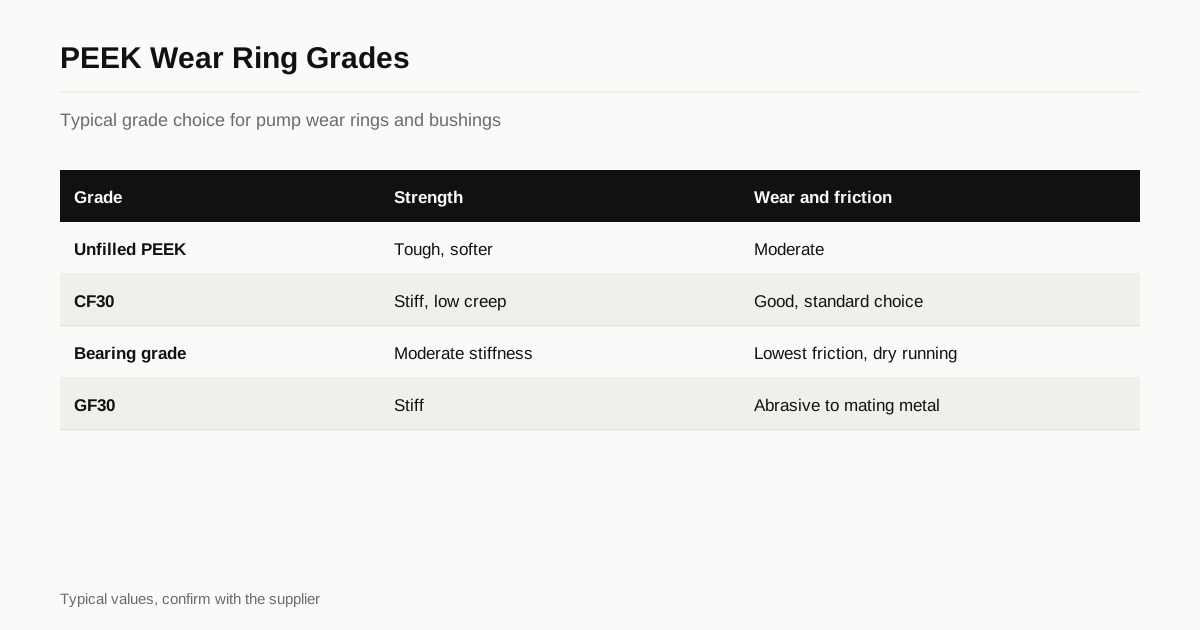
| Grade | Strength | Wear and friction | Typical use |
|---|---|---|---|
| Unfilled PEEK | Tough, softer | Moderate | Light duty, clean fluids |
| CF30 | Stiff, low creep | Good | Standard wear ring grade |
| Bearing grade (carbon, graphite, PTFE) | Moderate stiffness | Lowest friction, best dry running | Bushings, throat rings, dry start up |
| GF30 | Stiff | Abrasive to mating metal | Rarely used for wear |
CF30 is the common wear ring choice because carbon fibre raises stiffness, reduces creep and conducts heat away from the rubbing surface. Bearing grades add solid lubricants that lower friction and extend the time a ring can run dry. The trade-offs, with figures, are in the bearing grade guide and the CF30 vs GF30 comparison. Glass filled grades are stiff but can abrade the mating metal, so they are used for wear parts only with care.
Setting the clearance
For metal wear rings, API 610 sets minimum diametral running clearances that grow with ring diameter, on the order of a quarter to half a millimetre for common sizes. The numbers depend on the edition and the material pairing, so check the current standard and your specification. Metal pairs need those gaps because contact would gall and seize.
A PEEK ring can safely run closer. Pump makers who use PEEK or carbon filled PEEK rings often reduce clearance well below the metal minimums, which cuts leakage and lifts efficiency. The figure is the pump maker’s decision, based on testing, and a machine shop only has to hold the diameter the drawing calls for.
Three effects change the running gap:
- Thermal growth. PEEK expands about four times as much as steel. A ring fitted at 20 °C and run at 150 °C changes diameter by a significant amount for a ring of 150 mm.
- Fluid absorption. PEEK absorbs little water, but some fluids cause slight swelling. Check the compatibility in the chemical resistance guide.
- Press fit relaxation. A ring held by interference creeps and relaxes over time, which reduces grip.
Press fit and retention
Wear rings are held in the casing by an interference fit, often with a step or a dowel pin as a backup, because PEEK relaxes. Typical design points include:
- Wall thickness that is enough for the ring to hold its shape. Thin rings distort when pressed.
- Interference sized at the operating temperature. A ring that is tight cold may loosen when hot, and a ring that is tight hot may crack when cold.
- A chamfer on the leading edge and a stop shoulder to seat the ring.
- A locking feature, such as set screws or a retaining pin, where vibration or pressure reversals could move the ring.
The thermal fit calculator gives a quick estimate of the change. The tolerances guide explains why the machine shop and the assembler must measure at the same temperature.
Machining notes
Rings are turned, so they are simple. The risks are roundness and stress. A thin ring clamped hard in a chuck is machined round and springs oval when released. Soft jaws, light clamping and a finishing cut in a relaxed state fix that. Stress from stock affects dimensions after machining, so annealing between roughing and finishing is standard for tight rings. See annealing PEEK parts.
Surface finish on the running face matters. A rough surface wears the mating metal, and a very smooth one may not hold a lubricating film. Drawings typically call for a finish in the range of Ra 0.8 to 1.6 µm on running faces, with the exact value set by the pump maker.
Failure modes and replacement
Wear rings fail in four recognisable ways, and each points to a different fix.
| Symptom | Likely cause | Typical fix |
|---|---|---|
| Even wear, gap grows slowly | Normal wear, abrasive solids | Replace on schedule, harder counterface |
| Scoring and heat marks | Dry running or poor lubrication | Bearing grade, check start up |
| Ring loose in casing | Thermal growth or relaxed fit | Revise interference, add retention |
| Cracked or crushed ring | Thin wall or shock | Thicker section, tougher grade |
Abrasive solids in the fluid are the main enemy. PEEK is wear resistant, but sand, scale and catalyst fines cut any plastic ring quickly, and a harder counterface on the rotor, such as a coating or a hardened sleeve, extends life. If the fluid carries solids, mention it on the RFQ so the shop and the pump maker can pick a grade and a surface finish with that in mind.
Replacement is routine. A ring that has worn to the limit of the allowed clearance is pulled and replaced, which is far cheaper than a worn casing. Keeping a record of the clearance measured at each service gives an early view of wear rate, and a rising rate is a signal to look at alignment, bearing condition or fluid quality before the next ring wears out early. Spare rings made from the same lot of stock and to the same drawing keep fit consistent between services.
What to put on the RFQ
State the ring diameters and the running and interference fits at which temperature, the grade and supplier, the fluid and temperature range, whether dry running is expected, the surface finish and the roundness tolerance. Name any standard, such as API 610, that the pump follows. Send the drawing and we match you with up to three shops that turn PEEK wear parts, with a reply within 24 business hours.
See also: PEEK wear rings and bushings, the reference page with PV data and clearance tables.
Frequently asked questions
Why use PEEK instead of metal for pump wear rings?
A PEEK ring can rub the rotor without galling or seizing, so the pump can run a tighter clearance than metal on metal allows. That reduces internal leakage and lifts efficiency, and it tolerates dry running at start up and upset conditions far better than a metal ring.
Which PEEK grade suits wear rings and bushings?
Carbon fibre filled PEEK (CF30) and bearing grade blends with carbon, graphite and PTFE are the usual choices. They combine stiffness, low friction and wear resistance. Unfilled PEEK is too soft and wears faster, and glass filled PEEK can abrade the mating metal surface.
How does temperature change the running clearance of a PEEK wear ring?
PEEK grows faster with heat than the steel around and inside it. A ring pressed into a casing tightens its grip as it warms but its bore also changes size, so the running gap at temperature can differ from the cold gap. Size the fit at the pumped fluid temperature.
Need a quote for this part?
Send the drawing. We match you with up to 3 shops that cut your PEEK grade and reply within 24 business hours.
Get matched with a PEEK shop