Guides / Sourcing
Designing PEEK Gripper Fingers: Stiffness, Weight and Wear
October 19, 2026
Sources: manufacturer datasheets and published standards. See editorial standards.
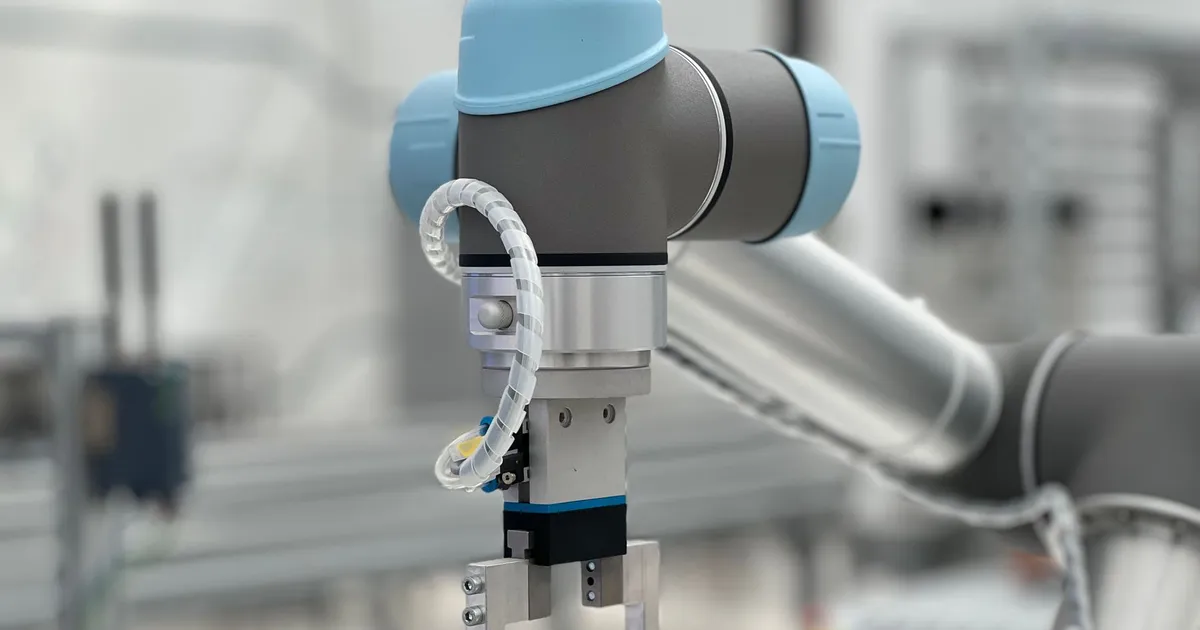
A gripper finger is a small part with a hard life. It closes thousands of times an hour, takes a grip force without bending, touches a part without marking it and weighs as little as possible, because every gram sits at the end of a robot arm. Aluminium and steel meet the stiffness requirement and fail at the others. PEEK, especially carbon filled, trades some stiffness for weight, insulation and gentleness, and that trade is good in many automation cells.
What a finger has to do
Four requirements pull against each other.
- Stiffness. The finger must not bend enough to lose the grip or shift the part.
- Low mass. A lighter finger lets the robot accelerate faster and reduces load on the joints and the gripper itself.
- Gentle contact. The finger should not scratch, dent or contaminate the part.
- Environment. Cleanrooms, washdown cells, hot parts and chemicals each add limits.
PEEK is stiff for a plastic and tough, with good wear and chemical resistance. Carbon filling raises stiffness sharply, which is why CF30 fingers are common where reach and grip force are high.
A worked example
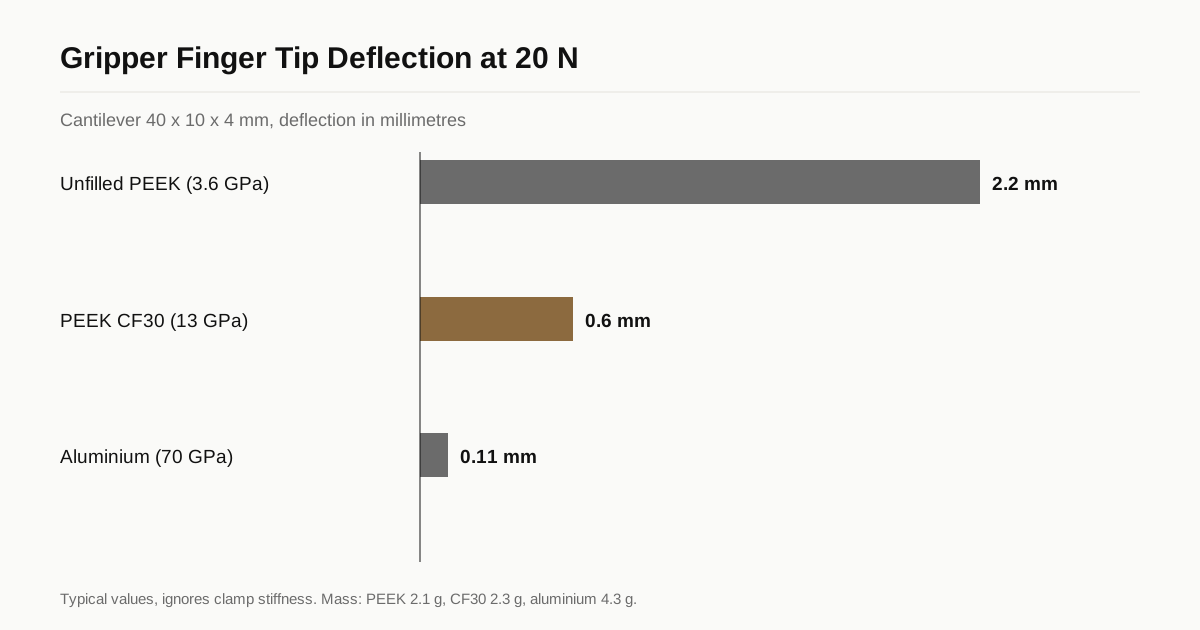
Take a simple cantilever finger 40 mm long with a cross-section 10 mm wide and 4 mm thick in the bending direction, loaded at the tip by a 20 N grip force. Tip deflection is the force times length cubed, divided by three times modulus times second moment of area. The second moment is 53 mm to the fourth.
| Material | Modulus, GPa | Tip deflection, mm | Finger mass, g |
|---|---|---|---|
| Unfilled PEEK | 3.6 | 2.2 | 2.1 |
| PEEK CF30 | 13 | 0.6 | 2.3 |
| Aluminium | 70 | 0.11 | 4.3 |
The figures are typical and illustrative. They ignore the stiffness of the clamp. Unfilled PEEK deflects twenty times as much as aluminium in this case, which is too much for a precise grip. CF30 brings deflection to a level many applications accept and keeps the mass at half the aluminium finger. The takeaway is that PEEK fingers work when the geometry is short, thick and ribbed, and when CF30 carries the load. Design rules for thick ribs and radii are in the material properties guide.
Choosing the grade
Natural PEEK suits short, thick fingers, insulating needs and clean or food-contact cells. It is the most forgiving at the contact edge and shows contamination.
CF30 suits long or thin fingers and high grip force. It is stiff and wear resistant, though it conducts and can mark soft parts at sharp edges. Edges need a radius, and the grade comparison is in CF30 vs GF30.
ESD grades suit static sensitive parts such as electronics and wafers, as covered in the ESD PEEK guide.
Bearing grades suit contact pads or slides where the finger moves against another surface, with references in the bearing grade guide.
For parts that must not be marked, a soft pad of another material bonded or clamped on the finger often beats a bare PEEK edge. If you plan to bond a pad, read bonding and welding PEEK for what holds.
Wear at the contact pad
The contact point takes the wear. Bare PEEK against a hard steel or ceramic part wears slowly, but abrasive parts, such as castings or sand-blasted surfaces, cut a finger quickly. Ways to extend life include:
- Replaceable pads, so a worn contact is a small cheap part, not the whole finger.
- A larger contact area to cut pressure.
- Serrations or a textured face cut into the finger, if grip needs a rough surface.
- A grade with lower wear, such as a bearing blend, where fingers slide.
Fingers in hot cells, such as handling parts from an oven, benefit from PEEK’s heat resistance. PEEK holds shape to well over 200 °C, where most plastics soften.
Machining notes and tolerances
Fingers are milled from plate or rod. The critical features are the mounting face and holes, which locate the finger on the gripper jaw, and the contact surfaces, which need flatness and parallelism. Typical tolerances are ±0.02 to ±0.05 mm on the mounting features, with flatness of the gripping face in the range of 0.02 to 0.05 mm.
Thin fingers bend as they are machined. Soft jaws, vacuum fixtures and a finishing cut after stress relief solve most of it. Annealing between roughing and finishing keeps flat surfaces flat, as covered in annealing PEEK parts. Measuring a finger at the same temperature as the assembly avoids disputes, as shown in the tolerances guide.
A set of fingers should be made together from the same stock, so that the pair matches in stiffness and size.
Cost and quantity
Fingers are usually one-off or small batch, so cost depends on setup and material. CF30 stock costs more than natural PEEK. The machining cost guide explains how cycle time and stock combine. Ordering spares with the first batch saves repeat setup.
Finger geometry that works in plastic
Plastic fingers reward a few simple design habits.
- Ribs instead of thickness. A rib along the bending direction adds stiffness for little mass, where a thicker finger adds both. Machined ribs work well in CF30.
- Radii at every inside corner. A sharp corner at the root of a finger is where cracks start, particularly under repeated grips.
- Short reach. Deflection grows with the cube of length, so shortening a finger by a fifth cuts deflection roughly in half. Where the reach is fixed, step the finger down in section only at the tip.
- Stiff mounting. A stiff finger on a loose mount still moves. Dowel pins or a close fitting step locate the finger, and screws only clamp it.
- Clearance for part variation. Real parts vary. Fingers that open wider than the worst case avoid collisions and reduce crash damage.
Crash tolerance and spares
Robots crash. A finger takes the hit, which is part of its job. PEEK handles impact better than glass filled grades, and CF30 is stiffer but less tolerant of shock. Many cells keep a small stock of spare fingers, machined from the same lot, so a crash costs minutes and not days. Order spares with the first batch, and keep the program and the drawing revision on file so replacements match the original exactly.
What to put on the RFQ
State the grade, grip force, finger length and reach, the mass target, the critical mounting tolerances, the contact surface finish, the environment and whether pads are separate. Give the quantity and whether you want spares. Send the drawing and we match you with up to three shops that machine plastic automation parts, with a reply within 24 business hours.
Frequently asked questions
Why make gripper fingers from PEEK instead of aluminium?
Weight, insulation and part protection. A PEEK finger weighs about half as much as an aluminium one of the same shape, so the robot moves faster with less load. It also insulates, resists chemicals and is softer than the part it grips. Aluminium is stiffer, so a thin finger may need CF30.
Which PEEK grade is best for gripper fingers?
CF30 is the usual choice when stiffness matters because it roughly triples the modulus of unfilled PEEK. Natural PEEK suits short fingers, insulating needs and clean applications. ESD grades protect static sensitive parts, and bearing grades suit contact pads that slide.
How accurate does a gripper finger need to be?
Mounting faces and the finger alignment usually carry the tight tolerances, around ±0.02 to ±0.05 mm. Flatness of the gripping surface and parallelism between the two fingers matter more than the outside dimensions, and PEEK needs measuring at a stated temperature.
Need a quote for this part?
Send the drawing. We match you with up to 3 shops that cut your PEEK grade and reply within 24 business hours.
Get matched with a PEEK shop