Guides / Machining
Deburring Machined PEEK and Cleaning It for Shipment
October 11, 2026
Sources: manufacturer datasheets and published standards. See editorial standards.
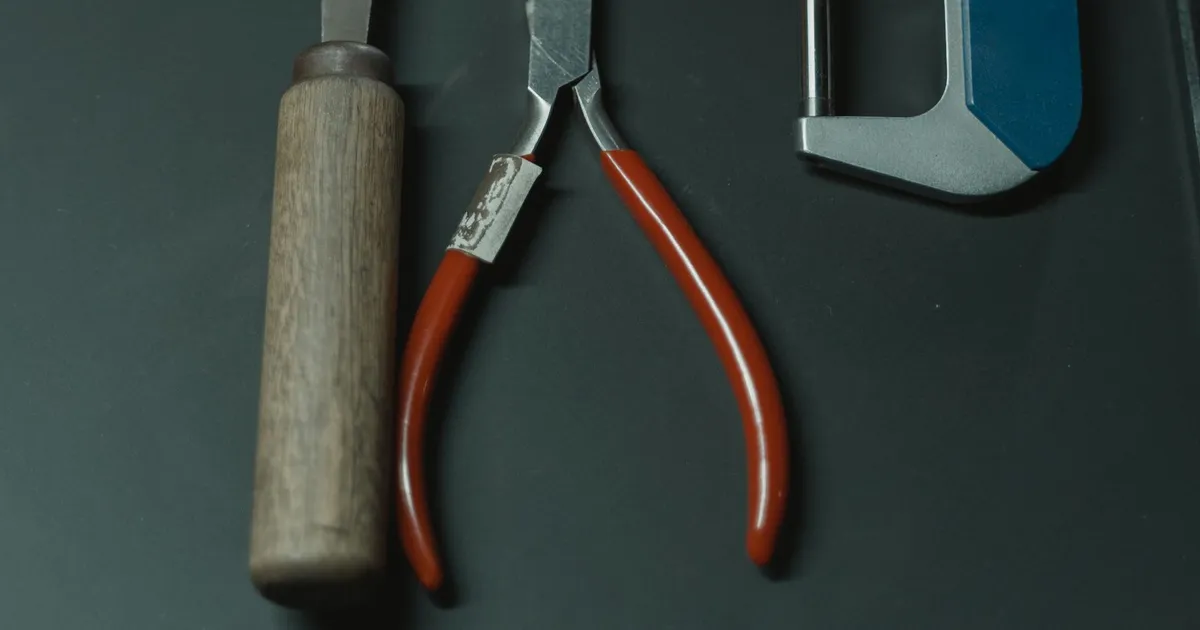
Burrs on a machined PEEK part are not sharp metal slivers. They are soft, stringy flaps that bend rather than break, and they hide in cross holes, grooves and thread roots. A part that passes dimensional inspection can still fail at the customer if a burr lifts in a fluid path or lodges in an assembly. The method used to remove it matters, and so does what is done to the part after it.
Why burrs form in PEEK
A sharp tool cuts PEEK cleanly. A dull one pushes the material and forms a burr along the exit edge, and a worn edge leaves stringy chips attached to the part. Burrs are worst at the exit of a hole, at the end of a cut-off, along the edge of a groove and wherever one cutter path ends against another feature.
The best deburring is prevention. A fresh tool, a light final pass and a planned tool path that exits a cut on a supported surface produce less burr than any later operation can remove. That is why the cutting practice in tooling, speeds and feeds belongs to this topic too.
Methods and what each does to PEEK
| Method | Suits | Risk | Typical cost level |
|---|---|---|---|
| Hand deburring with blade or scraper | Prototypes, accessible edges | Operator variation, scratches | Labour heavy |
| Rotary brush or abrasive nylon | External edges, light burrs | Rounds edges slightly | Low |
| Tumbling with plastic media | Small parts in bulk | Changes dimensions and finish | Low per part |
| Cryogenic deflashing | Small, repeat parts | Setup cost, brittle fracture of burrs | Medium |
| Chamfer cut at the machine | Edges on a known path | Needs tool path time | Low per part |
| Thermal deburring | Metals only | Distorts PEEK | Not suitable |
Hand deburring is the standard for prototypes and for features nobody can reach with a machine. A sharp blade or a scraper removes the flap without smearing it. The risk is variation between operators, so the drawing should state the finished edge.
Brushes and abrasive nylon clean light burrs from external edges and can leave a consistent small radius, but they cannot reach the inside of a cross hole.
Tumbling suits small parts that can tolerate a slightly softened edge. It changes the surface texture and dimensions, so it needs to be validated on tight-tolerance parts.
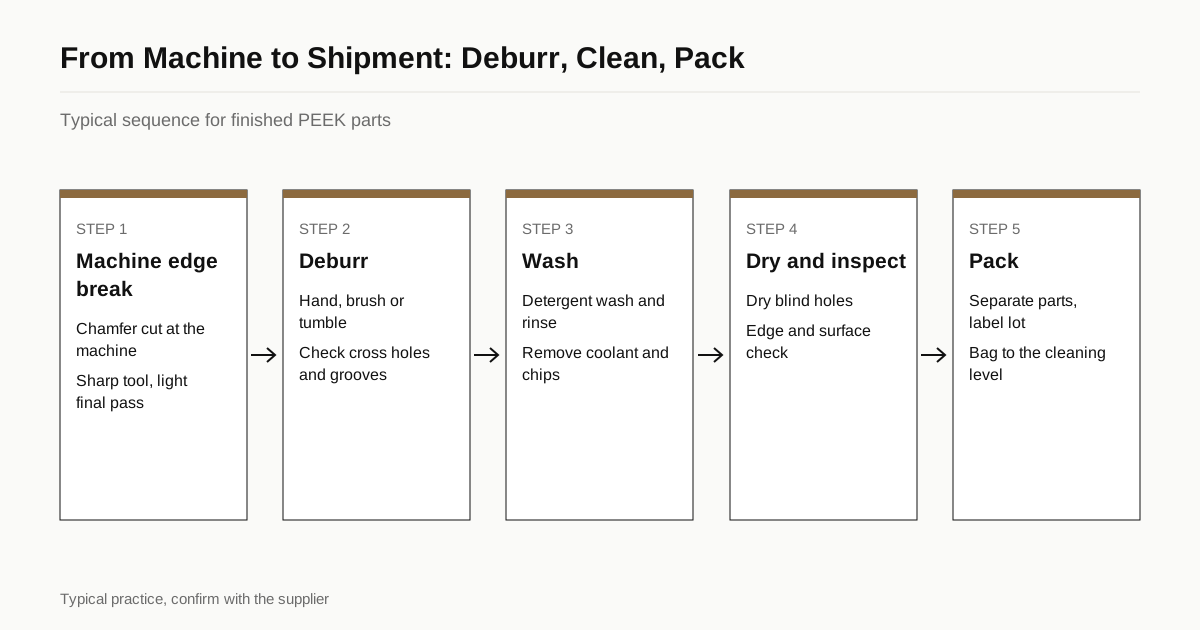
Cutting the edge break on the machine is the cleanest method. A chamfer tool follows the edge in the same setup and leaves a repeatable break. It adds seconds to the cycle and removes a manual step.
Internal burrs and cross holes
The hardest burrs sit where two bores meet. A cross hole drilled into a main bore leaves a burr on the inside wall that cannot be seen from outside and cannot be reached with a blade. Options include a deburring tool with a spring-loaded cutter that passes through the main bore, an abrasive flow method or a design change that offsets the holes so the burr lands on an accessible surface.
For fluid parts, ask how internal edges are inspected. A borescope or an air flow test shows what a visual check cannot. See the machining defects guide for how burrs and other defects show up at incoming inspection.
Cleaning after deburring
Machined PEEK arrives at the cleaning step with coolant film, fine chips, handling oils and often fingerprints. Cleaning removes them, and the level of cleaning depends on the end use.
- General industrial parts. A warm detergent wash, a rinse and a dry are typical. The purpose is to remove coolant and chips so parts do not stain or stick.
- Medical device components. Parts go through a documented wash, ultrasonic cleaning and a deionised water rinse, then packing in clean bags. The wash process, water quality and acceptance criteria are written down.
- Semiconductor parts. Cleaning targets particles and ionic residue. Parts are washed, dried and double bagged in a controlled environment. See cleanroom packing for semiconductor parts.
- Food and pharma parts. Cleaning removes lubricants and must not leave residues that contact the product. The wash chemistry is checked against the application.
PEEK tolerates most detergents and solvents, so material compatibility is rarely a problem. The real risk is residue left behind by a solvent that is not rinsed, or by a coolant that has gone rancid. Drying matters because trapped water in blind holes shows up later as a stain or a leak path.
Packing for shipment
A clean part can be spoiled in the box. Parts that scratch each other need separators or individual bags. Small parts need a count, not a weight. Cleanroom parts need bags and labels that match the cleaning level. Packing also determines whether a part with a tight tolerance is measured in a temperature-controlled room or in a warm warehouse. Inspecting PEEK parts covers that side.
Cost and what to ask for
Deburring is labour, and labour is where an RFQ comparison goes wrong. Two quotes can differ by a large amount simply because one includes careful hand finishing of every edge and the other assumes a quick pass.
| Requirement | Effect on cost |
|---|---|
| Edge break stated on the drawing | Low, done in the machine cycle |
| Break all sharp edges, no size | Medium, depends on operator judgement |
| Internal cross hole deburring | High, needs special tools or a design change |
| Inspection under magnification | Medium, adds a manual step |
| Cleanroom wash and double bag | Medium to high, needs a controlled area |
Three habits keep that cost honest. State the edge size on the drawing. List the features where access is difficult, and agree the method before the first batch. Ask for a first article with a photo of the critical edges, because a picture settles disputes that a text description cannot.
If the parts are small and numerous, ask whether the shop uses a fixture that deburrs several parts in one pass, or a tumbling method validated for your tolerance. A small change in how burrs are handled can move the part price more than a change in the grade.
What to put on the RFQ
Give the edge condition for every important edge, list the internal features that need deburring access and name the cleaning and packing level. If the parts are for medical or semiconductor use, say so up front because the cost of a controlled process is very different from a general clean. Send the drawing and we match you with up to three shops that finish PEEK parts to a stated edge and cleaning standard, with a reply within 24 business hours.
Frequently asked questions
Can PEEK be deburred with thermal deburring?
Generally no. Thermal deburring burns burrs off metal with a gas explosion. PEEK absorbs that heat and distorts, so shops use hand tools, brushes, fine abrasive media or cryogenic methods for plastics instead.
What cleaning process do machined PEEK parts need?
At least removal of coolant, chips and handling residue. Typically that is a warm detergent wash, a rinse in deionised water and drying. Medical and semiconductor parts add ultrasonic cleaning, cleanroom assembly and bagging, and a documented process.
How do I specify an edge condition for a PEEK part?
Give a chamfer or radius size on every edge that matters, for example 0.2 mm by 45 degrees, and say which edges may be left as machined. A note that only says break all sharp edges leaves the finish to the operator's judgement.
Need a quote for this part?
Send the drawing. We match you with up to 3 shops that cut your PEEK grade and reply within 24 business hours.
Get matched with a PEEK shop