Guides / Sourcing
Where PEEK Parts Fit in an EV Battery Cell Production Line
October 16, 2026
Sources: manufacturer datasheets and published standards. See editorial standards.
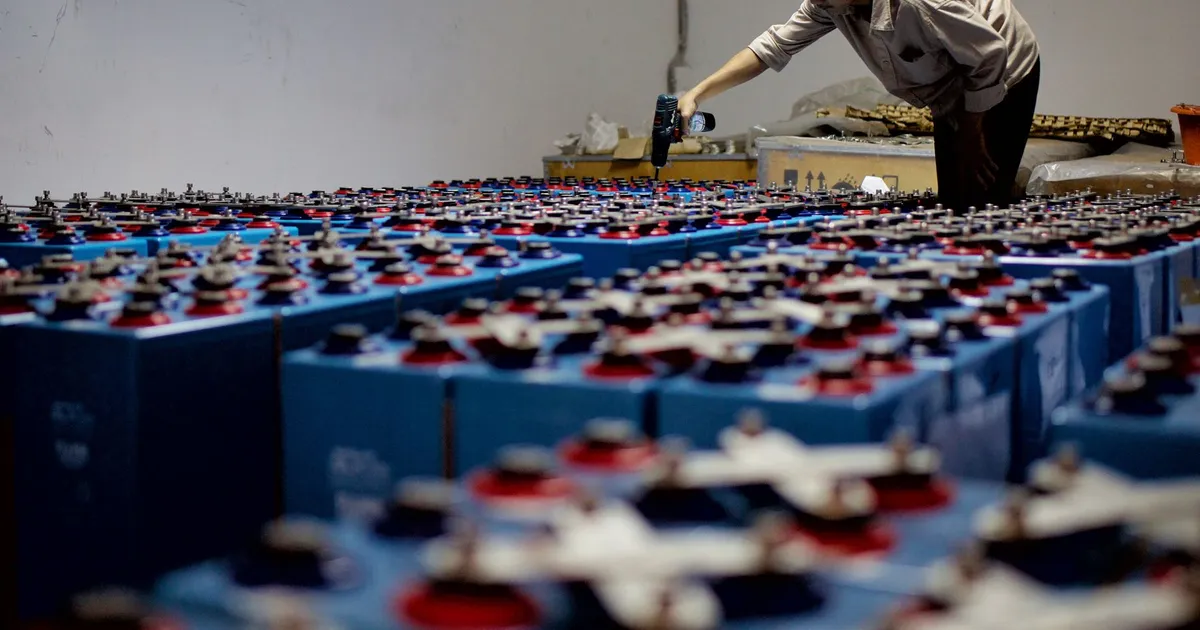
The parts people see in an electric vehicle are batteries and motors. The parts that make the batteries are less visible and in many ways more demanding. A cell line coats electrodes, stacks and winds them, fills them with electrolyte and charges them for the first time, all in rooms with almost no moisture and with a very low tolerance for metal particles. PEEK turns up in that equipment for a short list of reasons, and a machining order for those parts has requirements that a general PEEK drawing does not cover.
The conditions inside a cell line
Four conditions shape the material choice.
Dry rooms. Cell assembly takes place at very low dew points, because water reacts with electrolyte salts. A dry room is also a static generator, because low humidity lets charge build on plastics. Insulating parts attract dust and discharge onto sensitive materials.
Solvents. Electrode slurry uses solvents such as NMP, and electrolyte uses carbonate solvents. Parts near coating and filling stations must resist both.
Heat. Formation and ageing hold cells at elevated temperature, often in the range of 40 to 85 °C under clamping pressure. Fixtures must keep their shape and hold pressure for hours.
Particles. Metal and conductive particles are the enemy of a cell, because a particle can pierce a separator and cause an internal short. Equipment parts must not shed and must be cleaned to a defined level.
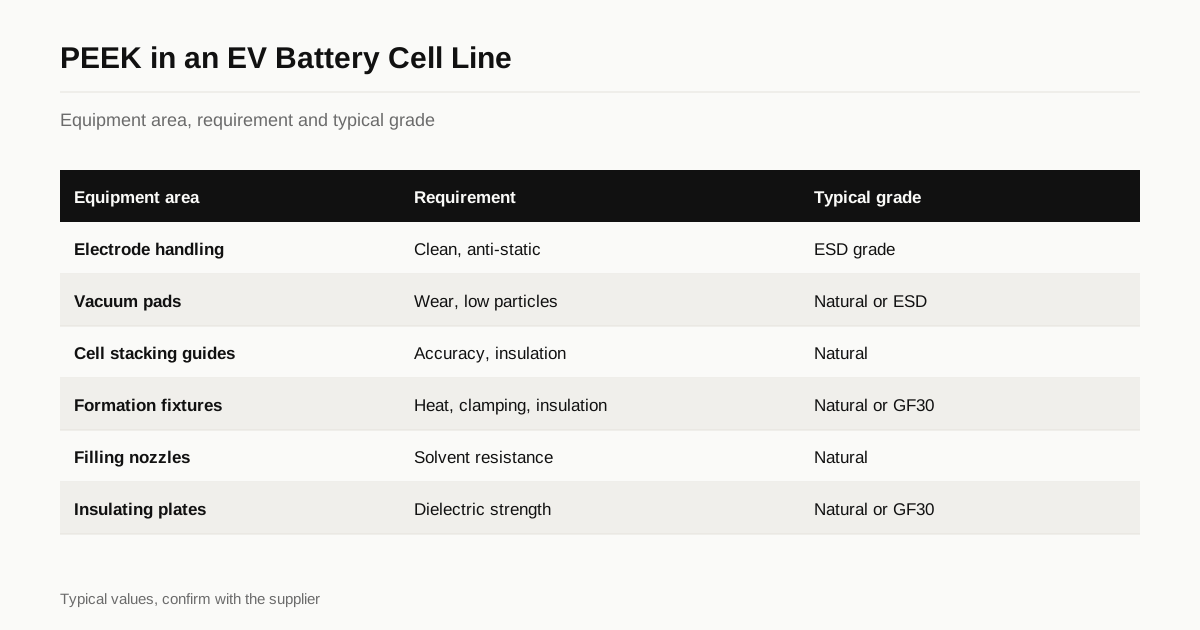
Where PEEK appears
| Equipment area | Requirement | Typical PEEK choice |
|---|---|---|
| Electrode handling and pick-up | Non-marking, clean, anti-static | ESD grade |
| Vacuum pads and grippers | Wear, low particle release | Natural or ESD |
| Cell stacking guides | Dimensional accuracy, insulation | Natural |
| Formation and ageing fixtures | Heat, clamping pressure, insulation | Natural or GF30 |
| Welding fixtures and tab tooling | Heat, insulation, wear | GF30 or CF30 near non-live parts |
| Filling nozzles and fittings | Solvent resistance, cleanliness | Natural |
| Spacers and insulating plates | Dielectric strength, stiffness | Natural or GF30 |
Natural PEEK suits parts near live tabs or terminals because it is an excellent insulator and shows contamination. An ESD grade suits parts that touch electrodes and separators in a dry room. The resistance ranges and test methods are in the ESD PEEK guide, and the same logic applies to battery lines.
Carbon filled PEEK conducts. A conductive fixture near cell tabs can short them, so carbon filled grades need a deliberate design reason. If a drawing just says PEEK, a shop may assume natural, and it is worth stating.
Grade and property choices
Natural PEEK gives insulation, chemical resistance and a clean look. It expands more with heat than filled grades, so long fixture plates warp and shift with temperature.
GF30 gives stiffness and lower expansion, helping long clamping plates stay flat during formation. It is electrically insulating, though glass fibre can leave a rougher surface and release fibre at worn edges.
CF30 gives the highest stiffness and good wear but conducts, so it is used away from live parts.
ESD grades hold a dissipative range and suit handling. See PEEK grades compared for how these differ.
Fixture flatness matters because clamping pressure uniformity affects formation. A plate that bows under heat gives uneven pressure and uneven cells. Design thick enough to resist bow, anneal between roughing and finishing and check flatness at temperature. See annealing PEEK parts and PEEK tolerances.
Chemical exposure
PEEK resists NMP and the common carbonate solvents. Electrolyte salts such as lithium hexafluorophosphate can form acidic species if moisture enters, and some of these attack many materials. PEEK performs well in most acidic conditions but is not immune to every strong acid, so check the supplier’s chemical data against your actual exposure. The chemical resistance guide shows how to read these tables.
Cleanliness and particle control
Battery buyers ask for parts that do not shed particles, especially metal. For a machined plastic part that means:
- Clean tools that have not cut metal, to avoid embedded metal debris.
- Sharp edges and a deburring step so nothing flakes off.
- A defined cleaning process and packing in clean bags.
- Magnet or particle checks where the buyer requires them.
These requirements resemble cleanroom machining for semiconductors. See cleanroom packing for how packing is specified.
Design details that help in a dry room
A dry room is a hard place for plastics, and a few design choices reduce trouble.
Avoid blind holes and crevices. Moisture and electrolyte residue collect in them and are hard to clean. Through holes, open grooves and generous radii are easier to wash and dry.
Specify surface finish. A smooth surface sheds particles and cleans well. A rough machined surface holds dust and can shed it later. Typical finishes on handling parts sit in the range of Ra 0.4 to 1.6 µm.
Mark parts without particles. Laser marking and ink marking both leave residue in different ways. Agree the method with the buyer and test it in the cleaning process.
Allow for static. Even insulating fixtures that never touch an electrode can collect charge and attract dust. If an insulating part sits near an exposed electrode stack, discuss grounding or an ESD grade with the line designer.
Plan for replacement. Wear pads, vacuum cups and guides wear out on a schedule. Make them separate, standard parts rather than features of a large plate, so a worn pad does not scrap an expensive fixture. Keep drawings and stock lots for repeat orders, so replacement parts match the originals.
Temperature, flatness and creep in formation fixtures
Formation plates hold cells under pressure for hours at elevated temperature. Creep under that sustained load changes thickness, and warp changes pressure distribution. Choose a grade with low creep, such as GF30, size the plate thick enough to resist bending and check flatness cold and hot. Use steel or ceramic stiffeners if the plate is large, and keep PEEK for the insulating face. A short pilot run with measured cell results is worth more than a calculation, because formation outcomes depend on more than the fixture.
Qualification and change control
Battery makers treat any change to a fixture as a process change. A new material lot, a different shop or an altered surface finish can shift cell results, so buyers often ask for lot traceability, a fixed drawing revision and notice before any change. Agree these terms with the shop at the start. Keep a golden sample of each approved part, so that a later batch can be compared by eye, by measurement and by a particle count against a known good reference.
What to put on the RFQ
State the line stage, the grade and whether it must insulate or dissipate, the dry room or cleanroom requirement, the solvent exposure, the temperature, flatness and tolerance requirements and the cleaning and packing level. Say whether metal particle checks are needed. Send the drawing and we match you with up to three shops that machine clean plastic parts, with a reply within 24 business hours.
Frequently asked questions
Why do battery equipment makers use PEEK instead of cheaper plastics?
Cell lines combine solvents, dry rooms, heat during formation and strict cleanliness. PEEK resists the solvents, holds shape at formation temperatures, is a strong insulator and can be machined clean. Cheaper plastics soften, absorb moisture or shed material in those conditions.
Should battery line parts be natural or carbon filled PEEK?
It depends on whether the part must insulate or dissipate. Fixtures near live cell tabs usually need natural PEEK as an insulator. Handling parts that touch electrodes and separators in a dry room often need an ESD grade, because static builds easily at low humidity.
Does PEEK resist battery electrolyte?
PEEK resists the common carbonate solvents used in lithium ion electrolyte. Electrolyte salts can form acidic by-products when moisture is present, so check the exact exposure and the supplier's chemical data for the grade before committing.
Need a quote for this part?
Send the drawing. We match you with up to 3 shops that cut your PEEK grade and reply within 24 business hours.
Get matched with a PEEK shop