Guides / Grades
PEEK or PPS: Which Plastic Fits a Pump, Valve or Electrical Part
October 22, 2026
Sources: manufacturer datasheets and published standards. See editorial standards.

PPS is the plastic a pump or valve engineer reaches for when PEEK looks too expensive. It resists chemicals, it holds its shape at high temperature, and it costs far less. For a large share of fluid parts the cheaper plastic is the right answer. For another share it is a false economy, and the failure shows up months later as a cracked seat or a swollen bush. The comparison is worth doing properly.
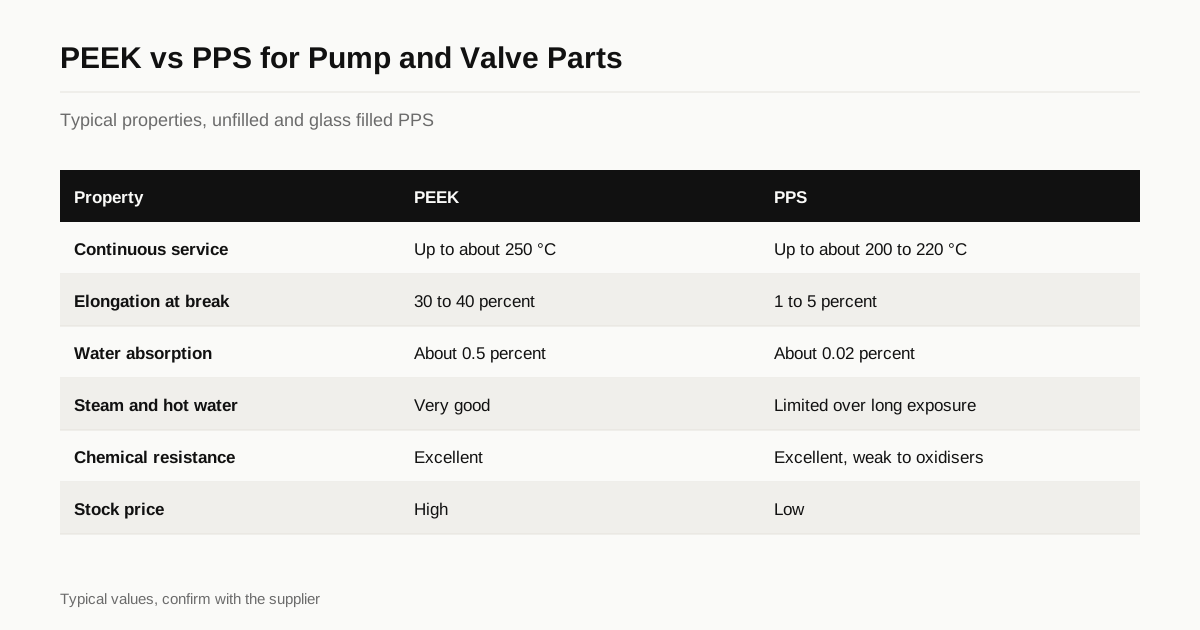
The properties side by side
Typical values for machining stock. Always check the datasheet for the grade you will use.
| Property | PEEK, unfilled | PPS, unfilled or lightly filled | PPS, glass filled |
|---|---|---|---|
| Glass transition | About 143 °C | About 90 °C | About 90 °C |
| Melting point | About 343 °C | About 280 °C | About 280 °C |
| Continuous service | Up to about 250 °C | Up to about 200 °C | Up to about 220 °C |
| Elongation at break | 30 to 40 percent | 3 to 5 percent | 1 to 2 percent |
| Water absorption | About 0.5 percent | About 0.02 percent | About 0.02 percent |
| Relative stock price | High | Low | Low to medium |
PPS absorbs almost no water, which makes it dimensionally steady in humid service. PEEK is tougher by an order of magnitude and keeps useful strength well above PPS’s glass transition. The reason PEEK holds up better at temperature is the higher glass transition, covered in the PEEK properties guide.
Chemical resistance
Both are among the most chemical-resistant plastics. PPS has no known solvent below about 200 °C and handles most acids, bases and fuels. It is attacked by strong oxidising acids, such as concentrated nitric acid, and by some chlorinated solvents at elevated temperatures. PEEK resists nearly everything, with weakness mainly to concentrated sulphuric acid and a few strong oxidisers.
The practical difference is rarely in a single chemical. It is in the combination of chemistry, temperature and stress. A part that sees hot water with dissolved chemicals under load may do well in PEEK and crack in PPS. The detailed table is in the chemical resistance guide, and the approach to checking compatibility applies to both materials.
Toughness and part design
PPS is stiff and brittle. Glass filled PPS has high modulus and very low creep, which suits a rigid housing or a spacer, but its elongation of 1 to 2 percent means it does not forgive stress concentrations. Sharp internal corners, snap fits, thin ribs and press fits are risky.
PEEK yields before it breaks, so it tolerates press fits, thin features and some impact. That is the property that makes PEEK the usual choice for seat rings, backup rings and bushings that see pressure cycling or shock. The valve seat wear guide shows where those loads appear.
Where each material fits
Pumps. Wear rings, impeller sleeves and bushings in chemical pumps often run a hard counter-face in a wet environment. PEEK, especially bearing grade, performs well and tolerates dry running better. PPS suits stationary or housing parts and wear rings where clearances are controlled and shock is low.
Valves. Seats, seals and stem bushings see sealing force, temperature and media. PEEK handles higher pressure and the impact of a closing valve. PPS suits lower pressure seats in moderate temperature service.
Electrical. Both are good insulators. Glass filled PPS is popular for connector housings, bobbins and relay parts because it is rigid, flame retardant and easy to mould. Machined parts for harsh electrical environments, such as high temperature insulators, favour PEEK when hydrolysis and toughness matter. See PEEK connector bodies and insulators.
Machining behaviour
PPS machines well, but glass filled grades wear tools quickly and PPS chips easily at edges. Burr formation is lower than in PEEK. Unfilled PPS is often not available in the same range of sizes as PEEK, and many stock shapes are glass or carbon filled. Both materials hold stress from extrusion, so annealing between roughing and finishing applies to both. See annealing PEEK parts for the practice.
Cost per part depends on stock price and cycle time. PPS stock is cheaper, and parts often come out cheaper overall, though a complex part dominated by machine time narrows the gap. The machining cost guide explains the cost split.
A simple decision path
- Service above about 200 °C continuous, or steam exposure: PEEK.
- Shock, press fits, thin features or cyclic loads: PEEK.
- Rigid, stationary part in a chemical environment under about 200 °C: PPS is worth pricing.
- Cost-driven part where both would work: get quotes for both and test PPS on a sample.
- Medical, food or other regulated use: check the grade certification first, because PPS grades with the same documentation may not exist.
Failure modes to watch
Both materials fail in service in ways that differ, and knowing the typical failure helps in choosing and in testing.
PPS failure modes. Cracking is the main one. A press fit, a sharp corner or a sudden shock can crack glass filled PPS, sometimes weeks after assembly when stress relaxes. Slow crack growth under sustained stress in a chemical environment can also occur. PPS can also lose strength after long exposure to hot water or steam, so a part that passed a short test may fail after months.
PEEK failure modes. Wear and creep are more usual. Unfilled PEEK under sustained load at high temperature creeps, and a filled grade reduces that. PEEK is attacked by strong sulphuric acid, and carbon filled PEEK can be a galvanic concern in some electrolytes against certain metals. Cracking is rare unless the part carries a stress concentration and is exposed to an aggressive solvent.
Testing that helps both materials:
- A soak test in the actual fluid at service temperature, with part dimensions and mass measured before and after.
- A pressure cycling test for seats and rings, with leak checks.
- A dry-run test for wear rings and bushings, if upset conditions are possible.
If a part has failed in PPS and you are considering PEEK as a fix, find out why before changing. A crack from a sharp corner moves to a new material unchanged, and the radius is the cheaper fix.
What to put on the RFQ
State the fluid, concentration, temperature range, pressure and whether the part moves. Name the grade or ask for both options. If you are open to either plastic, say so and ask for the price difference. Send the drawing and we match you with up to three shops that cut engineering plastics, with a reply within 24 business hours.
Frequently asked questions
Is PPS cheaper than PEEK?
Yes, usually by a clear margin. Machining stock of PPS typically costs a fraction of PEEK, and it machines well, so a PPS part is often noticeably cheaper. The price gap is the main reason to consider PPS when the service conditions allow.
Which is tougher, PEEK or PPS?
PEEK. Unfilled PEEK stretches before it breaks and absorbs impact, while PPS, especially glass filled, is stiff but brittle. A part with snap features, thin walls or shock loads usually favours PEEK.
Can PPS replace PEEK in hot water or steam?
Sometimes at lower temperatures, but check carefully. PEEK keeps its properties in hot water and steam far better, and long exposure to steam is where PPS most often falls short. Test or ask for supplier data on your exact conditions.
Need a quote for this part?
Send the drawing. We match you with up to 3 shops that cut your PEEK grade and reply within 24 business hours.
Get matched with a PEEK shop