Guides / Sourcing
Machining PEEK Connector Bodies and Insulators That Survive the Field
October 15, 2026
Sources: manufacturer datasheets and published standards. See editorial standards.
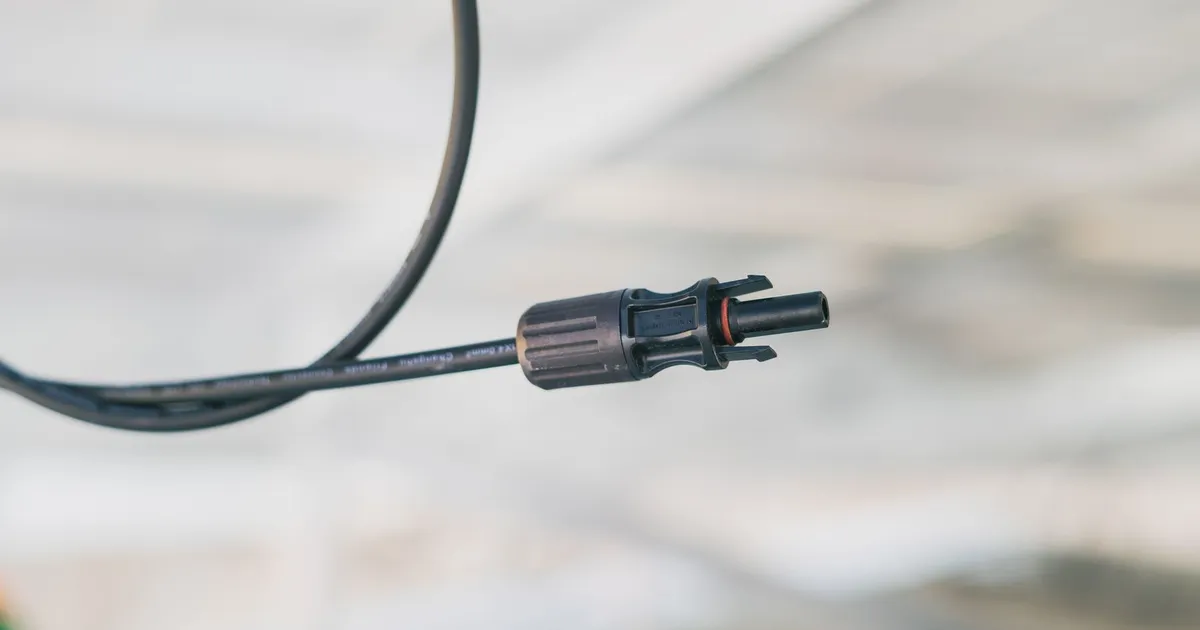
A connector body looks like a simple moulded block with holes in it. In the field it holds contacts in alignment, keeps live conductors apart, seals against fluids and survives heat and vibration that destroy cheaper plastics. When it fails, the connector fails, and usually the equipment behind it. PEEK is chosen where nylon, PBT and PPS reach their limit, and machined PEEK is the usual route for low volume, high value connectors, prototypes and replacements.
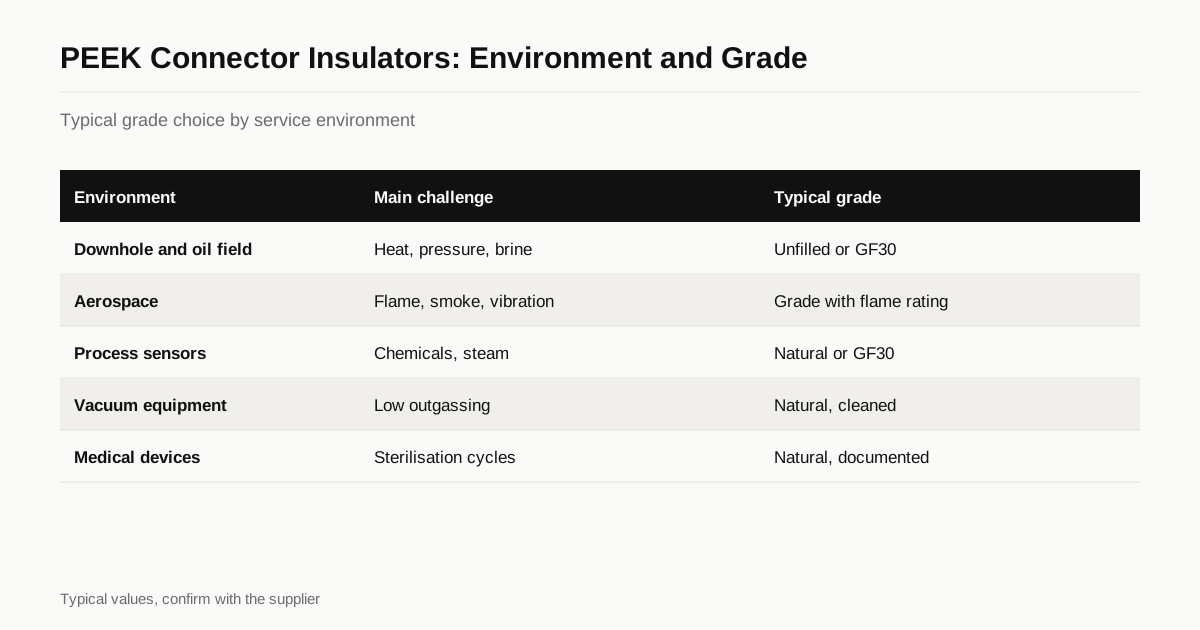
Where PEEK connector bodies are used
Typical environments are downhole tools, aerospace and defence harnesses, industrial sensors, vacuum and process equipment and medical devices. The reasons vary but come down to a short list: temperature, fluids, flame behaviour and long life.
| Environment | Main challenge | Typical PEEK choice |
|---|---|---|
| Downhole and oil field | Heat, pressure, brine, hydrocarbons | Unfilled or GF30, tested at temperature |
| Aerospace | Flame, smoke, weight, vibration | Grade with documented flame rating |
| Process sensors | Chemicals, steam | Natural or GF30 |
| Vacuum equipment | Low outgassing, heat | Natural, cleaned and baked |
| Medical devices | Sterilisation cycles | Natural, grade documentation |
PEEK is inherently flame retardant, typically reaching UL 94 V-0 at thin sections without added retardants, and it releases little smoke. The rating attaches to a grade and thickness, so check the datasheet for the one you buy. See PEEK parts for oil and gas for the downhole side and aerospace PEEK parts for the flight side.
Grade choice
Unfilled PEEK is tough and has good electrical properties. It suits parts with thin walls, snap-in features and retention clips. Its higher thermal expansion and lower stiffness make fit control harder.
Glass filled PEEK (GF30) is stiffer, expands less and creeps less under contact spring load. It is the usual choice for pin retention and fit to a metal shell. The trade is lower toughness, so sharp corners and thin ribs need radii. See CF30 vs GF30 for the property differences. Carbon filled grades are generally avoided in insulators because carbon conducts.
Colour matters electrically too. A black pigmented PEEK can have lower resistivity than natural. For a high voltage body, check the datasheet, as discussed in black vs natural PEEK.
Design features that decide success
Pin and contact holes. A contact is held by friction, a shoulder or a retaining clip. Holes need a controlled diameter and a clean finish so the contact seats without cracking the web between neighbouring holes. Drilling many small, deep, parallel holes is a classic job where drift matters, and the drilling guide explains how shops hold position.
Web thickness. The material between adjacent holes carries load from contact insertion. Thin webs crack. A design review should check minimum web thickness against contact retention force.
Seal faces and O-ring grooves. Surfaces that seal against a metal shell or a mating connector need flatness and finish. Groove dimensions follow the O-ring standard, and edge radii protect the seal during assembly.
Keyways and polarising features. Sharp inside corners start cracks. Radii help.
Threads and locking features. Where a coupling nut or insert threads into the body, follow the thread method guidance.
Fit to the metal shell
A PEEK body sits inside a steel or aluminium shell, and the two expand at different rates. Unfilled PEEK expands about four times as much as steel, and GF30 about half that. A body that fits snugly at 20 °C can become loose or tight at 150 °C. The result is either a body that rattles and wears, or a shell that cracks the insulator.
Design the fit at the service temperature range, not at room temperature. The thermal fit calculator and the tolerance guide explain how. Many designs use a small clearance with an O-ring or a spring washer to take up the difference.
Moisture, fluids and long life
PEEK absorbs little water, so insulation resistance stays high in humid service. Hot water and steam do not hydrolyse it. Hydrocarbons and most solvents leave it unchanged. The weak points are concentrated sulphuric acid and a few strong oxidisers, listed in the chemical resistance guide.
Residual stress is another risk. A body machined from stressed stock can crack at a hole or corner weeks later, particularly after exposure to a solvent that attacks stressed material. Annealing after roughing reduces that, as described in annealing PEEK parts.
Electrical tests and what they prove
A connector insulator is tested by what it does, not by what it is. Three tests cover most of the cases a buyer asks for.
| Test | What it shows | Typical use |
|---|---|---|
| Insulation resistance | Leakage between contacts and to the shell | Every body, often at temperature |
| Dielectric withstand | Whether the body survives a stated overvoltage | Sample or every unit |
| Partial discharge or corona | Weak points that arc at high voltage | High voltage designs |
Insulation resistance depends on humidity and surface cleanliness, so a body tested after handling can read lower than a clean one. Cleaning before test, and a defined test humidity, make results repeatable. Because PEEK holds very little water, it typically keeps insulation resistance high in humid air, which is one reason it replaces nylon here.
A body with a flaw, such as a void in the stock or a crack at a hole, can pass at low voltage and fail at high voltage. Voids in thick plate or rod are a known risk, and a shop that sources certified stock and inspects cut faces catches many of them.
Vibration and retention
Connectors in engines, tools and vehicles see vibration for years. Contacts retained by friction or a clip can fret and loosen. Design features that help include a positive shoulder behind each contact, a retention clip in a groove cut with a radius, and an interference between insert and shell that survives the thermal range. PEEK’s creep resistance helps, and GF30 does better than unfilled. Test with a vibration profile that matches service and check for loose contacts and cracked webs afterwards.
Burrs at hole entries can also hold a contact off its seat, so an edge break on every hole and a clean finish are part of the retention design, not only of appearance.
What to put on the RFQ
Give the grade and supplier, the environment and temperature range, the hole pattern with positional tolerance, the minimum web thickness, the shell dimensions and fit, the sealing features and the electrical test, such as insulation resistance or dielectric withstand. Send the drawing and we match you with up to three shops that machine electrical insulators, with a reply within 24 business hours.
See also: UL 94 flammability ratings and RTI explained.
See also: PEEK electrical insulators, insulating screws and connector bodies, the reference page with dielectric data by grade.
Frequently asked questions
Why use PEEK for a connector insulator instead of nylon or PBT?
PEEK keeps its shape and insulation at far higher temperatures, resists oils, fuels and hot water and does not absorb enough moisture to change its size or electrical behaviour. It costs more, so it is used where the environment would degrade cheaper plastics.
Should a connector body be unfilled or glass filled PEEK?
Glass filled PEEK is stiffer and expands less, which helps pin retention and fit to a metal shell. Unfilled PEEK is tougher and suits parts with thin snap features. Many connector bodies use GF30, with fillet radii and thick enough walls to avoid cracking.
How tight must pin holes be in a PEEK insulator?
Tight enough to hold the contact without cracking the web between holes, usually in the range of ±0.03 to ±0.05 mm for a pin hole, depending on contact design. The contact maker's drawing sets the figure, and the bore finish and edge break matter as much as the size.
Need a quote for this part?
Send the drawing. We match you with up to 3 shops that cut your PEEK grade and reply within 24 business hours.
Get matched with a PEEK shop