Guides / Grades
Black PEEK or Natural PEEK: What the Colour Changes
October 6, 2026
Sources: manufacturer datasheets and published standards. See editorial standards.
The colour of a PEEK part looks like a cosmetic choice. Natural PEEK is a light tan to beige. Black PEEK is the same polymer carrying a small amount of carbon black or another dark pigment. For many parts it makes no difference. For some it changes electrical behaviour, inspection, approvals and the risk of a mix-up on the shop floor. A short list of questions settles whether the colour matters for your part.
What the pigment is and what it does
Black PEEK is usually natural resin compounded with a small percentage of carbon black. Other colours use mineral or organic pigments, but black is the common one. At typical loadings the effect on mechanical properties is small. Tensile strength, modulus and heat resistance are close to the natural grade of the same family, and the datasheet will show the exact figures.
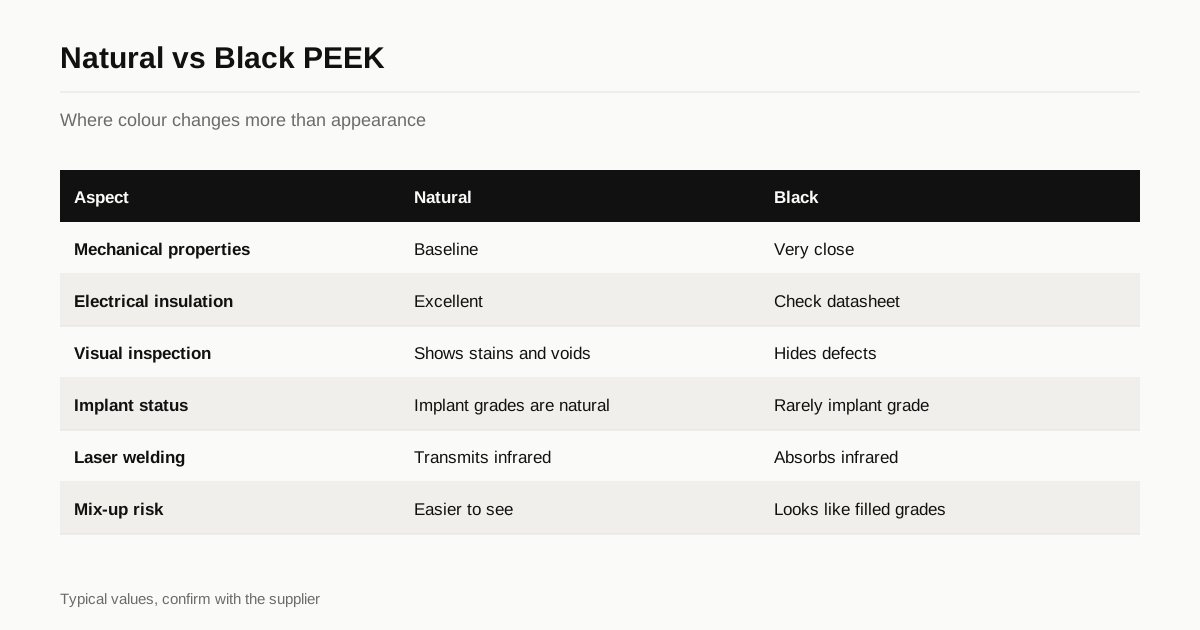
| Aspect | Natural PEEK | Black PEEK |
|---|---|---|
| Appearance | Tan to beige | Black |
| Mechanical properties | Baseline | Very close |
| Electrical insulation | Excellent | Usually good, may fall at higher loadings |
| UV and light absorption | Moderate | Higher, absorbs light and heat |
| Inspection of voids and stains | Easy to see | Hides defects |
| Typical medical status | Implant grades are natural | Rarely implant grade |
| Laser welding role | Transmits near-infrared light | Absorbs it |
Carbon black conducts. At low loading the compound stays insulating, but surface and volume resistivity can fall and become less predictable, especially if the pigment disperses unevenly. For a high voltage insulator or a part with a tight resistivity requirement, check the datasheet for the black grade, and do not assume the natural figures apply. See PEEK vs Ultem for insulators for how electrical needs shape the choice.
When the colour matters
Medical. Implant grade PEEK sold to ASTM F2026 is natural, with documented testing for that grade. A black or coloured compound is a different material with different documentation. Instruments and non-implant parts may use coloured grades, such as black or blue for visibility, but the biocompatibility paperwork follows the exact grade. See implant grade PEEK compliance.
Food and pharma. Pigments need compliance with the relevant food contact rules for the grade. Natural PEEK has a simpler paper trail. Colour coded black or blue parts are common in processing equipment, where contamination visibility matters, because a black fragment is easy to find in a pale product. Food contact compliance covers what to ask.
Semiconductor. Natural PEEK is often preferred for contact with wafers because it shows contamination and avoids carbon dust. Black can also arise from filler, as in ESD grades, which is a deliberate change. See ESD PEEK for wafer handling.
Laser welding and marking. Black material absorbs near-infrared laser light and natural material transmits it, so the two colours are often paired in a laser weld. Marking behaves differently on each colour, and black parts take a light laser mark well.
Heat treatment. Black parts absorb radiant heat more than natural parts, which matters little in a convection oven but can change surface temperature in radiant heating.
Inspection and the shop floor
Natural PEEK is useful for what it reveals. A burn mark from a dull tool, a stain from coolant, a void in a thick plate or a line of contamination shows as a colour change on a light surface. Black hides these. A shop machining black PEEK relies more on dimensional and surface checks and less on visual cues. The machining defects guide describes what shows up and how.
Traceability is the other side. Natural PEEK from different suppliers and filled grades such as glass or carbon often look similar to each other, so lot labels and certificates carry the identity. Black stock can look the same regardless of grade, so a mix-up between a plain black and a carbon filled black cannot be spotted by eye. Confirm lot numbers and certificates, and keep them with the part. The material verification guide explains how.
A simple way to choose
- Is the part regulated, medical, food or semiconductor? Start from natural and confirm.
- Does it need tight electrical insulation? Check the black grade datasheet or choose natural.
- Is visual inspection important? Natural.
- Will the part be laser welded to another part? Pair one natural and one black.
- Otherwise, choose by availability and price. Black is often easier to find in some sizes.
Heat, light and ageing
Colour affects how a part ages in sunlight and how it heats up. Carbon black absorbs ultraviolet light and protects the polymer below the surface, so black PEEK generally tolerates outdoor or lamp exposure a little better than natural, which can yellow or darken with long UV exposure. For most indoor industrial parts this is irrelevant. For a sensor housing or a camera mount on outdoor equipment, it can matter.
Black parts also absorb radiant heat. Near a lamp, a furnace window or a laser, a black part runs hotter than a natural part in the same position. That change is small compared with the margin of a PEEK part in most designs, but it counts when a design runs close to its temperature limit.
Cost and availability
Pricing for natural and black PEEK stock is often close, and the better indicator is availability in the size you need. Natural PEEK is the most widely stocked form. Black stock may be a pigmented grade or a separate compounded product, and some sizes may be listed only in one colour. Where a design allows either, ask the shop which it can buy in the size needed without a minimum order, since that choice can change lead time more than price.
If the choice is truly open, specify the requirement and let the shop choose: for example, PEEK of a stated grade, natural or black, insulating, with lot certificate. That wording avoids a rejected delivery over colour and keeps the property requirement in force.
Marking, labelling and incoming checks
Colour changes how a part can be identified. Laser marking on natural PEEK is often faint and may need a marking additive or a different laser setting, while black PEEK takes a high contrast mark readily. If a part needs a lot number or a data matrix code, say so on the drawing and agree a mark test on a sample, because a mark that cannot be read at incoming inspection is a rejected part.
At incoming inspection, a quick colour check is a useful first screen. A part that should be natural and arrives dark, or the reverse, has been made from the wrong stock. It is a screen only, and it cannot separate one black grade from another.
Colour has its own section in our guide to PEEK grade selection, next to temperature, filler and documents.
What to put on the RFQ
State the colour, the exact grade and supplier, whether certified stock is needed and any electrical or regulatory requirement. If colour is not important, say you accept either and ask for the price difference. Send the drawing and we match you with up to three shops, with a reply within 24 business hours.
Frequently asked questions
Is black PEEK weaker than natural PEEK?
Not in a way that matters for most parts. The mechanical properties of black and natural PEEK from the same resin family are very close, because the pigment loading is small. Differences are mainly in electrical behaviour, appearance and what each colour hides or shows.
Can black PEEK be used for implants?
Implant grade claims belong to a specific named grade and its documentation, and the implant grades supplied to ASTM F2026 are natural or specific approved colours. A black pigmented PEEK is not implant grade unless the supplier says so for that exact grade.
Why do some buyers insist on natural PEEK?
Natural PEEK lets you see contamination, voids and burn marks, and it avoids any question about what the pigment or carrier added. Medical, food and semiconductor buyers often specify natural for those reasons.
Need a quote for this part?
Send the drawing. We match you with up to 3 shops that cut your PEEK grade and reply within 24 business hours.
Get matched with a PEEK shop